Integration via Wiegand
The Wiegand feature enables the Akuvox device to act as a controller or a card reader.
Set it up on the Device > Wiegand > Wiegand interface.
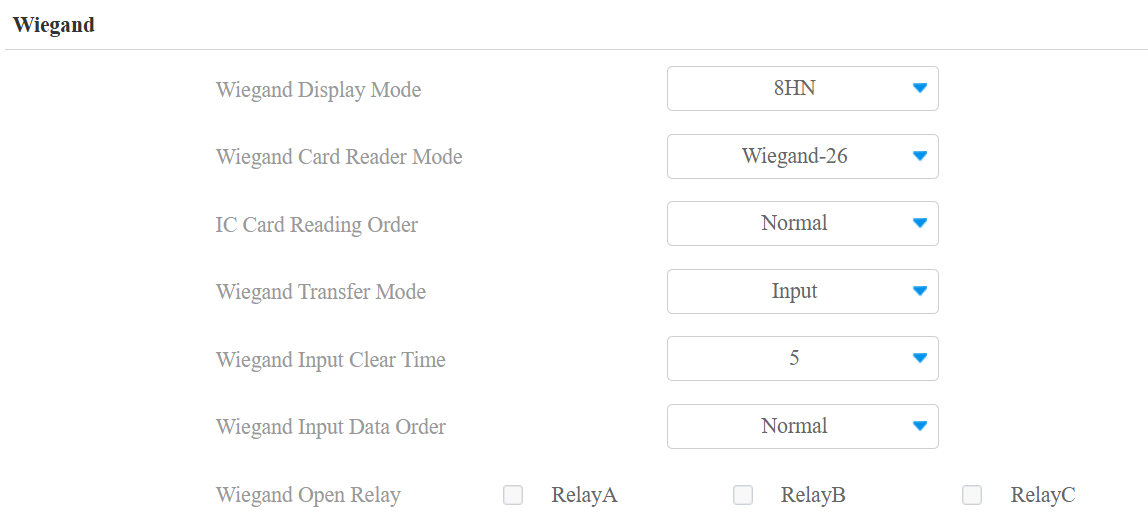
Wiegand Display Mode: Select the Wiegand card code format from the provided options.
Ignore Facility Code: This option is available when 6H3D5D(WG26) is selected. When enabled, the first three bits of the cards will be ignored for successful card reading.
Wiegand Card Reader Mode: The transmission format should be identical between the door phone and the third-party device. It is Wiegand-26 by default.
IC Card Reading Order: This option only works when Wiegand-26 is selected.
Normal: The device will read the last three bytes of the IC card. For example, if the IC card number is 840C9F50, 0C9F50 will be read.
Reversed: The device will read the first three bytes of the IC card. For example, if the IC card number is 840C9F50, 840C9F will be read.
Wiegand Transfer Mode:
Input: The device serves as a receiver.
Wiegand Input Clear Time: When the interval of entering passwords exceeds the time. All entered passwords will be cleared.
Wiegand Input Data Order: Set the Wiegand input data sequence between Normal and Reversed. If you select Reversed, then the input card number will be reversed.
Output: The device serves as a sender. If users can only open the door by swiping an RF card, select the Wiegand transfer mode as Output.
Wiegand Output Basic Data Order: Set the sequence of the card data before going through the Wiegand conversion and outputting the card code.
For example, if the card data is 0x11 0x22 0x33 0x44 and the Reversed option is selected, the data will be 0x44 0x33 0x22 0x11.
Wiegand Output Data Order: Determine the sequence of the card data after the Wiegand conversion.
For example, if the card data is 0x11 0x22 0x33 0x44 0x55, it will be 0x33 0x44 0x55 after the Wiegand conversion(e.g., Wiegand 26). If Reversed is selected, the card data is 0x55 0x44 0x33.
Wiegand Output CRC: It is enabled by default for Wiegand data inspection. Disabling it may lead to integration failure with third-party devices.
RF Card/PIN/QR Code Verification: When enabled, the device will verify whether the credential is assigned to a user. If it is not, a prompt "Opening Door Failed" will pop up on the door phone screen. When disabled, the door phone will not perform local verification.
Convert To Card No. Output: The device serves as a sender. If users are assigned multiple door-opening methods, select the Wiegand transfer mode as Convert To Card No. Output.
Wiegand Open Relay: Check the relay to be triggered through Wiegand.
When the device is in Wiegand Output mode, you can set the Wiegand PIN code output format that determines how data is transmitted. The format should be consistent with that of the third-party device.
Set it up on the Device > Wiegand > Convert To Wiegand Output interface.

8 bits per digit: When users press "1" on the keypad, the binary data will be transmitted in 8 bits, "11100001".
4 bits per digit: When users press "1" on the keypad, the binary data will be transmitted in 4 bits, "0001".
All at once: After users enter the whole PIN code, the data will be transmitted according to the Wiegand card reader mode.
Note
Click here to view more information on Wiegand settings including:
Akuvox devices work as Wiegand input/output;
Wiegand Card Reader Connection.
Facility Code Setting
A facility code is a unique number in access control cards. It identifies the device that issued the card.
When the Wiegand Transfer Mode is Output, you can set up the facility code on the Device > Wiegand interface.

Facility Code: The value ranges from 0 to 255. If filled in, the first two digits of the card number will be replaced by the code. If the code is less than 2 digits, a zero will be automatically added to the card number.
Tip
Since the Facility Code replaces the first two digits of the original card number, to keep the original card number intact, you can manually configure the Wiegand Card Reader Mode.
For example, if the card number is 3 bytes (Wiegand-26), you can select Wiegand-34 (4 bytes) to ensure the Facility Code replaces the first two digits with 0 instead of the original number.
Wiegand Virtual Door Mode
This feature determines which relay to open when a credential is read from a Wiegand device.
Set it up on the Device > Wiegand interface.

Enabled: It is enabled by default.
When enabled, the door phone gives priority to the relay(s) configured in Wiegand Open Relay.
When a user presents their credentials via Wiegand, the door phone will open the relay(s) defined in the Wiegand Open Relay.
If no relay is configured, the door phone will open the relay(s) assigned to the user.
When disabled, a relay will open only if it is allowed both in the Wiegand Open Relay and in the user’s relay permissions.
Note
If two-factor authentication methods are used and one of them comes from a Wiegand device, the door phone will follow the relay opening rules set in the Wiegand settings.
Integration via HTTP API
HTTP API is designed to achieve a network-based integration between the third-party device and the Akuvox device.
Set it up on the web Setting > HTTP API interface.
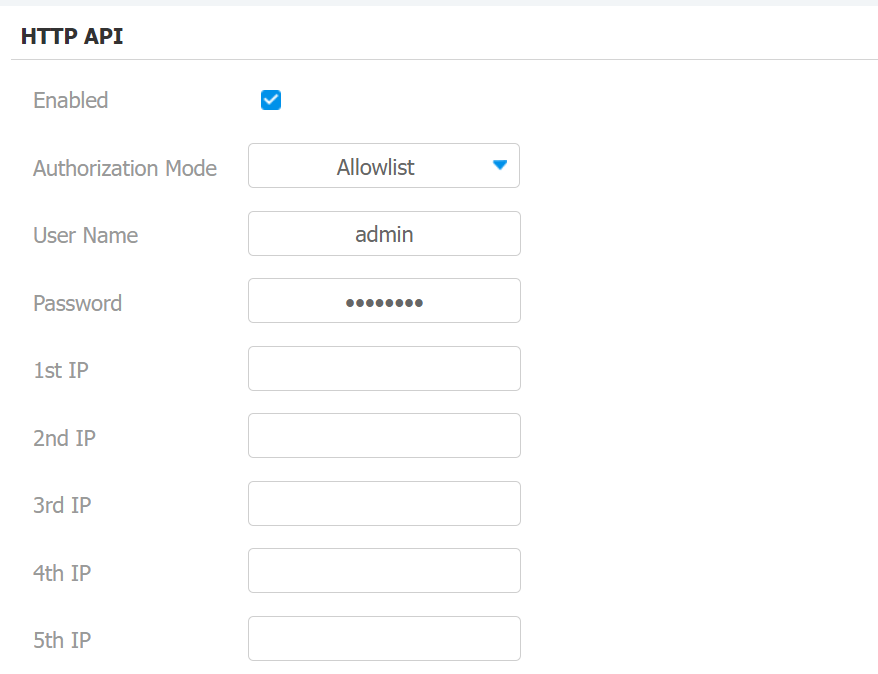
Enabled: Enable or disable the HTTP API function for third-party integration. If the function is disabled, any request to initiate the integration will be denied and return HTTP 403 forbidden status.
Authorization Mode: Select among the following options: None, Normal, Allowlist, Basic, Digest, and Token for authorization type, which will be explained in detail in the following chart.
User Name: Enter the user name when Basic or Digest authorization mode is selected. The default username is admin.
Password: Enter the password when Basic or Digest authorization mode is selected. The default password is admin.
1st IP-5th IP: Enter the IP address of the third-party devices when the Allowlist authorization is selected for the integration.
Please refer to the following description for the authentication mode:
NO. | Authorization Mode | Description |
|---|---|---|
1 | None | No authentication is required for HTTP API, as it is only used for demo testing. |
2 | Normal | This mode is used by Akuvox developers only. |
3 | Allowlist | If this mode is selected, you are only required to fill in the IP address of the third-party device for the authentication. The allowlist is suitable for operation in the LAN. |
4 | Basic | If this mode is selected, you are required to fill in the username and password for the authentication. In the Authorization field of the HTTP request header, use the Base64 encode method to encode of username and password. |
5 | Digest | The password encryption method only supports MD5. MD5( Message-Digest Algorithm) In the Authorization field of HTTP request header: WWW-Authenticate: Digest realm="HTTPAPI",qop="auth,auth-int",nonce="xx", opaque="xx". |
6 | Token | This mode is used by Akuvox developers only. |
Integration with Third-party Access Control Server
The device can transmit credential data to a third-party server without doing any verification. The generation and verification of the data are conducted on the third-party server.
Set it up on the Access Control > Relay > Third-party Integration interface.
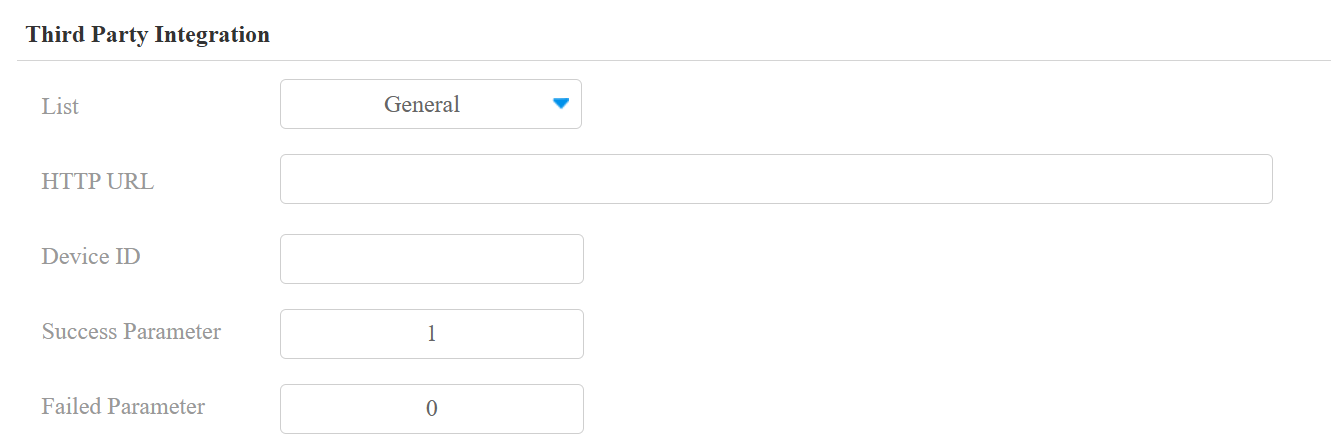
List:
None: Disable the feature.
General: Transmit the QR code-linked HTTP URL in Akuvox’s method.
HTTP URL: Enter the HTTP command format provided by the third-party service provider. After scanning the QR code, the HTTP command will carry the dynamic QR code information automatically before it is sent to the QR code server for verification. See the example: http://{Server IP}:8090/api/visitor/scan?codeKey={QRCode}&deviceId={DeviceID}.
Device ID: The device ID is provided by the third-party server. It will be added to the HTTP command automatically when using a QR code for door access.
Success Parameter: Receiving this value indicates that opening the door succeeds.
Failed Parameter: Receiving this value indicates that opening the door fails.
Customize: Transmit access credential data in a customized method. When Face is selected, the device performs local face recognition first. If no matching face is detected, authentication fails. If a match is found, the associated User ID or PIN is submitted to the third-party server for further verification.
Prompt on LCD: Select Default to adopt the Akuvox door phone’s door-opening prompt; Select Return Value to use the return value from the third-party server as the prompt.
Remote Verification: Specify which access credentials will be verified by the third-party server.
Available options depend on the configured Authentication Mode. When Multi-Factor Authentication Mode is enabled,
Option
Description
QR Code
The device scans the QR code and sends it directly to the third-party server. No local verification is performed.
Multi-Factor
The device first checks whether the authentication method matches the configured method.
If not matched → User is prompted to use the correct method.
If matched → The collected credentials are sent to the server for verification (no local verification).
HTTP URL: Enter the HTTP command format provided by the third-party service provider. After a QR code scan, card swipe, face recognition, or PIN entry, the device automatically replaces variables in the URL and sends the request to the server.
Example format:
http://{Server IP}:8090/api/visitor/scan?codeKey={QRCode}/{Card}/{UserID}/{Pin}/{Face}&deviceId={DeviceID}.
If a user swipes a card, the URL will be http://192.168.35.123:8090/api/visitor/scan?codeKey={QRCode}/123456/{UserID}/{Pin}/{Face}&deviceId=1.
Multi-Factor HTTP URL Format: In Multi-Factor Authentication mode, the example format is: http://{Server IP}:8090/api/visitor/scan?codeKey={Token}/{Type}&deviceId={DeviceID}.
Variable
Description
{Token}
Credential collected in the current authentication step.
{Type}
Two-factor authentication type:
1 = RF Card + PIN
3 = Face + RF Card
4 = Face + PIN
Device ID: The device ID is provided by the third-party server. It will be added to the HTTP command automatically.
Success Parameter: Receiving this value indicates that opening the door succeeds.
Failed Parameter: Receiving this value indicates that opening the door fails.
Integration via RS485
You can connect the device to an external device such as SR01 or an OSDP-based card reader via RS485. To make the connection effective, you need to select the right RS485 mode.
Click here to view the detailed configuration of the OSDP feature.
Set it up on the Device > RS485 interface.
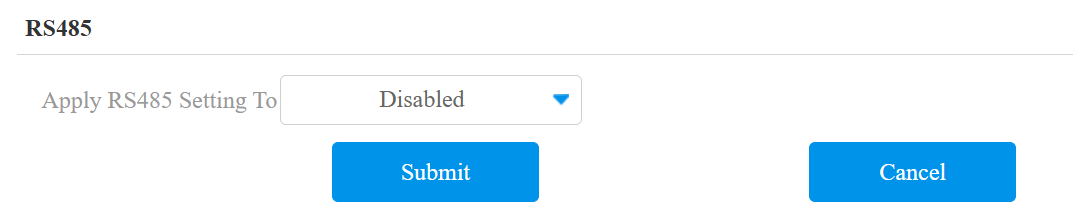
Disabled: The RS485 function is disabled.
Others: Select it when the device works with the security relay(SR01).
OSDP: The device is connected to an OSDP-based external device, such as a card reader.
Transfer Mode: Select the RS485 working mode, Output, or Input.
When Output is selected, configure the following options:
Local Relay Verification: Set whether to carry out the access credentials verification. When unchecked, door-opening failure prompts will not be given.
Encryption: Check this option when the protocol is encrypted.
Encryption Key: When it is filled, OSDP will use this value for encryption, employing a customized protocol for communication; When it is left empty, OSDP will use the default encrypted protocol for communication. It must be 32 bits long and can include numbers (0-9) and letters (a-f, A-F).
When Input is selected, configure the following options:
Scan for Readers: Click Scan to detect the connected card reader.
Encryption: Check this option when the OSDP protocol is encrypted.
Encryption Key: Fill in the key when Encryption is checked. If the output device is a third-party card reader, please confirm the key with the service provider.
Modify Key: Click to modify the encryption key, which must be 32 bits long and can include numbers (0-9) and letters (a-f, A-F).
Connection Status: Display whether the reader is online and connected properly.
OSDP Open Relay: Check the door to be opened.
Details: Click to view the card reader’s information.
LED Display Screen: Select it when the device is connected to LED displays via RS485 interface. This feature is used for the Smart Parking scenario where the device is connected to the SmartPlus Cloud and controls access for a parking lot.
Baud Rate: The baud rate used by the connected LED display. The default value is 115200.
Brand: The brand of the connected LED display. Supported brands: Wuxi Opto and SNT. The available address settings vary depending on the selected brand.
RS485 Address: A unique address for each LED display.
License Plate LED Display Duration:
Waiting Display Duration: Defines how long the recognized license plate remains displayed while the R29 is waiting for the cloud response. The default is 30 seconds. Range: 20 to 300 seconds.
Extra Display Duration: Defines how long the recognized license plate and prompt remain displayed after the cloud response is received. The default is 10 seconds. Range: 0 to 30 seconds.
Note
Click here to view how to configure LED screen display on R29.
RS485 Virtual Door Mode
This feature determines which relay to open when a credential is read from an OSDP(RS485) device.
Enabled: It is enabled by default.
When enabled, the door phone gives priority to the relay(s) configured in OSDP Open Relay.
When a user presents their credentials, the door phone will open the relay(s) defined in the OSDP Open Relay.
If no relay is configured, the door phone will open the relay(s) assigned to the user.
When disabled, a relay will open only if it is allowed both in the OSDP Open Relay and in the user’s relay permissions.
Power Output Control
The device can serve as a power supply for the external relays. Click here to view power output requirements.
To set it up, go to the web Access Control > Relay > 12V Relay Output interface.
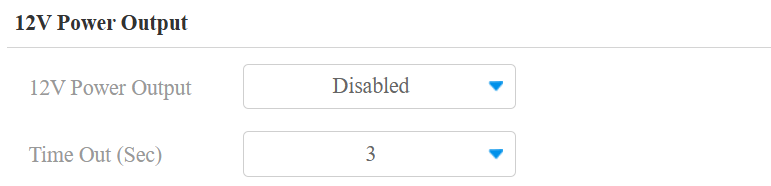
12V Power Output:
Always: Provide continuous power to the third-party device.
Triggered by Open Relay: Provide power to the third-party device via 12 output and GND interface during the timeout when the status of relays is shifted from low to high.
Time Out (Sec): Select the power supply time duration after the relay is triggered from 3, 5, and 10. It is 3 seconds by default.
Integration with Control4
The device supports integration with Control4, which enables users to call, monitor, and open doors on the Control4 panel.
Click here to learn the detailed configuration and other models supporting the integration.
To enable the integration, turn on a switch on the Device > Control4 interface.
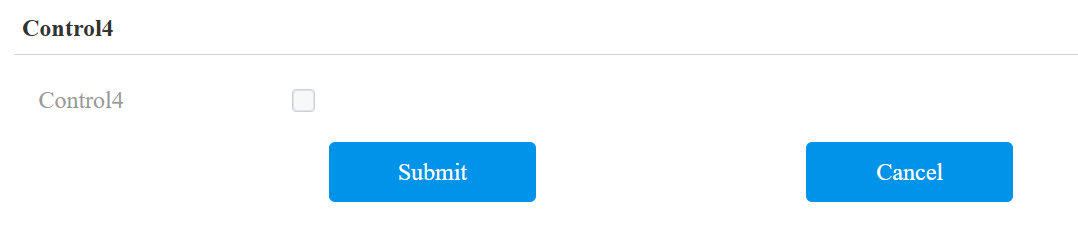
Control4: When enabled, High Security Mode, RTSP Authentication, and Discovery Mode will all be disabled.