Audio Codec Configuration
The door phone supports three types of Codec (PCMU, PCMA, and G722) for encoding and decoding the audio data during the call session. Each type of Codec varies in terms of sound quality. You can select the specific codec with different bandwidths and sample rates flexibly according to the actual network environment.
It is only available for SIP calls. To do the configuration on device web Account > Advanced interface.
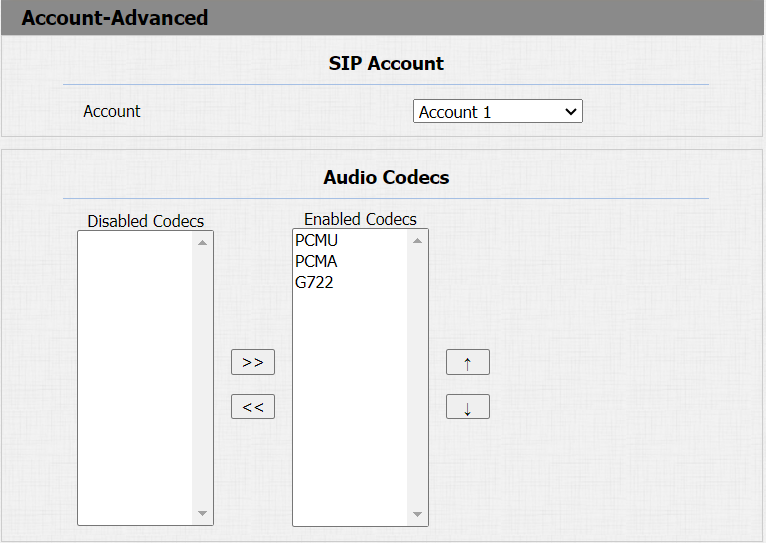
Please refer to the bandwidth consumption and sample rate for the four codecs types below:
| Codec Type | Bandwidth Consumption | Sample Rate |
|---|---|---|
| PCMA | 64 kbit/s | 8kHZ |
| PCMU | 64 kbit/s | 8kHZ |
| G722 | 64 kbit/s | 16kHZ |
Video Codec Configuration
The device supports the H264 codec that provides better video quality at a much lower bit rate with different video quality and payload.
To set up video codec on web Account > Advanced interface.
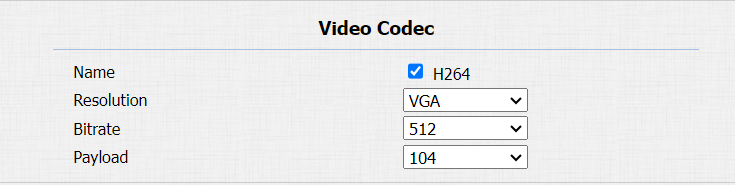
Parameter Set-up:
- Name: check to select the H264 video codec format for the door phone video stream. H264 is the video codec by default.
- Resolution: select the code resolution for the video quality among four options: CIF, VGA, 4CIF, and 720P according to your actual network environment.
- Bitrate: select the video stream bit rate (ranging from 320-2048). The greater the bit rate is, the larger the data transmitted every second in amount. Therefore the video will be clearer. While the default code bit rate is 512.
- Payload: select the payload type (ranging from 90-118) to configure the audio/video configuration file. The default payload is 104.
Configure DTMF Data Transmission
In order to achieve door access via DTMF code or some other applications, you are required to properly configure DTMF in order to establish a DTMF-based data transmission between the device and other intercom devices.
DTMF Type Differences:
Inband | DTMF signals are transmitted within the same audio channel as voice data. Simple implementation but signal distortion may occur with highly compressed codecs (e.g., G.729). |
RFC2833 | Transmits DTMF as special event packets over RTP (Real-Time Transport Protocol), known as out-of-band transmission. Reliable and unaffected by codecs. |
Info | Sends DTMF signals via SIP (Session Initiation Protocol) signaling channel. Separate from voice transmission, ensuring audio quality. |
Info+Inband | Combines Info and Inband methods. |
Info+RFC2833 | Combines both Info and RFC2833 methods. |
Info+Inband+RFC2833 | All three methods are used simultaneously. |
Go to Account > Advanced > DTMF interface.

Parameter Set-up:
- Type: select DTMF mode among six options: Inband, RFC2833, Info, Info+Inband, Info+Inband+RFC2833, and Info+RFC2833 based on the specific DTMF transmission type of the third party device to be matched with as the party for receiving signal data.
- How to Notify DTMF: select among four types: Disable, DTMF, DTMF-Relay, and Telephone-Event according to the specific type adopted by the third party device. You are required to set it up only when the third-party device to be matched with adopts Info mode.
- DTMF Payload: set the payload according to the specific data transmission payload agreed on between the sender and receiver during the data transmission.