Web Relay is an electrical relay with a built-in web server. Akuvox door phones can control third-party web relay devices through HTTP commands for remote door opening.
This article describes how to configure Web Relay and trigger door opening through DTMF codes, RF cards, or SmartPlus Cloud.
Prerequisites
Before configuring Web Relay, ensure that:
The Web Relay device is connected to the network.
The Web Relay IP address, username, password, and HTTP command are obtained from the Web Relay service provider.
Set up Web Relay
Use the device IP to log into its web interface. The default username and password are admin.
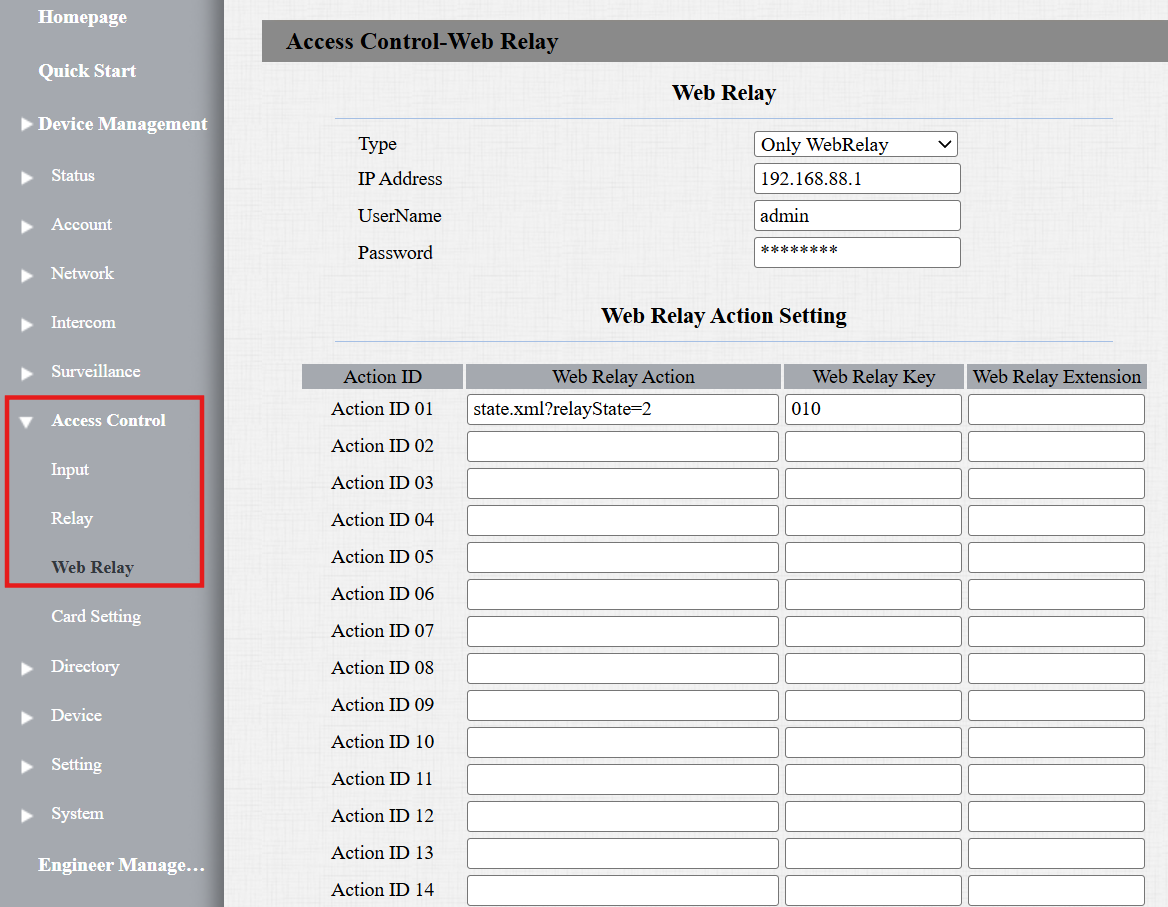
Navigate to the Access Control > Web Relay interface.
Select Web Relay or Both in the Type field.
Only Web Relay: Trigger the Web Relay to open the door.
Both Local Relay and Web Relay: Trigger the local relay or Web Relay to open the door, and the local relay takes priority over Web Relay.
Enter the IP Address, User Name, and Password provided by the Web Relay service provider.
Enter the HTTP command in the Web Relay Action field. One of the supported formats is state.xml?relayState=2.
Note
If you want to control more than one web relay using the HTTP GET method with a complete HTTP command, leave the IP address field blank. You can configure up to 50 commands.
If you did not enter the IP address, username, and password, you need to enter the complete HTTP command in a format such as http://{Username}:{Password}@{IP address}/state.xml?relayState=2.
For detailed instructions on Web Relay, please refer to the Web Relay manual on WebRelay’s official website.
Optional Configuration:
The Web Relay Key allows users to trigger the Web Relay using a DTMF code. In the Web Relay Key field, enter the DTMF code. Then, the door can ONLY be opened via DTMF code and RF card. Otherwise, it can be opened using all the device-supporting methods.
Note
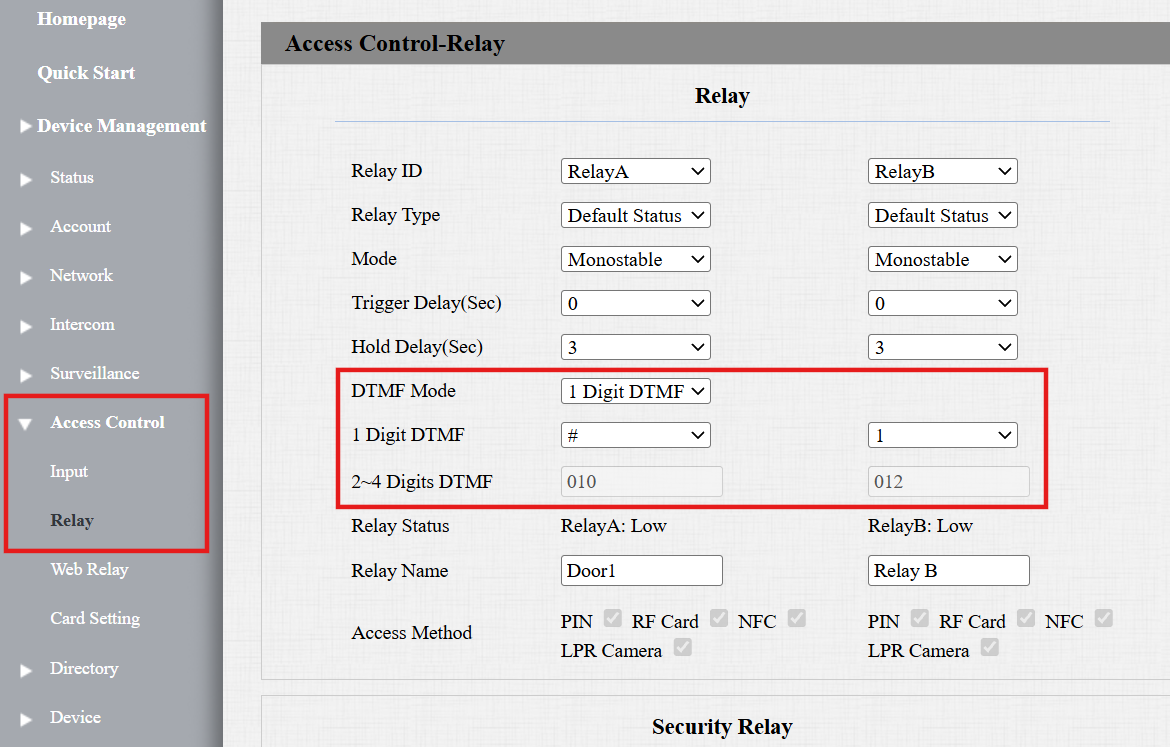
The DTMF code should be the same in the Web Relay Key field and DTMF settings.
The Action ID must match the Web Relay Settings and local access methods settings or the SmartPlus Cloud configuration.
To allow a specific device to trigger the Web Relay through a DTMF code, enter the device SIP/IP number in the Web Relay Extension field.
Trigger Web Relay
Different device models support various access methods. This section provides examples of web relay trigger via DTMF and RF cards.
Trigger Web Relay via DTMF Code
Door Phone Configuration
Navigate to the door phone’s Access Control > Relay interface.
Configure the DTMF code of RelayA or RelayB.
Select the DTMF Mode that determines the number of the DTMF code.
Select 1-digit DTMF or enter the code of 2 to 4 digits.
Click Submit.
Indoor Monitor Configuration
Use the device IP to log into its web interface. The default username and password are admin.
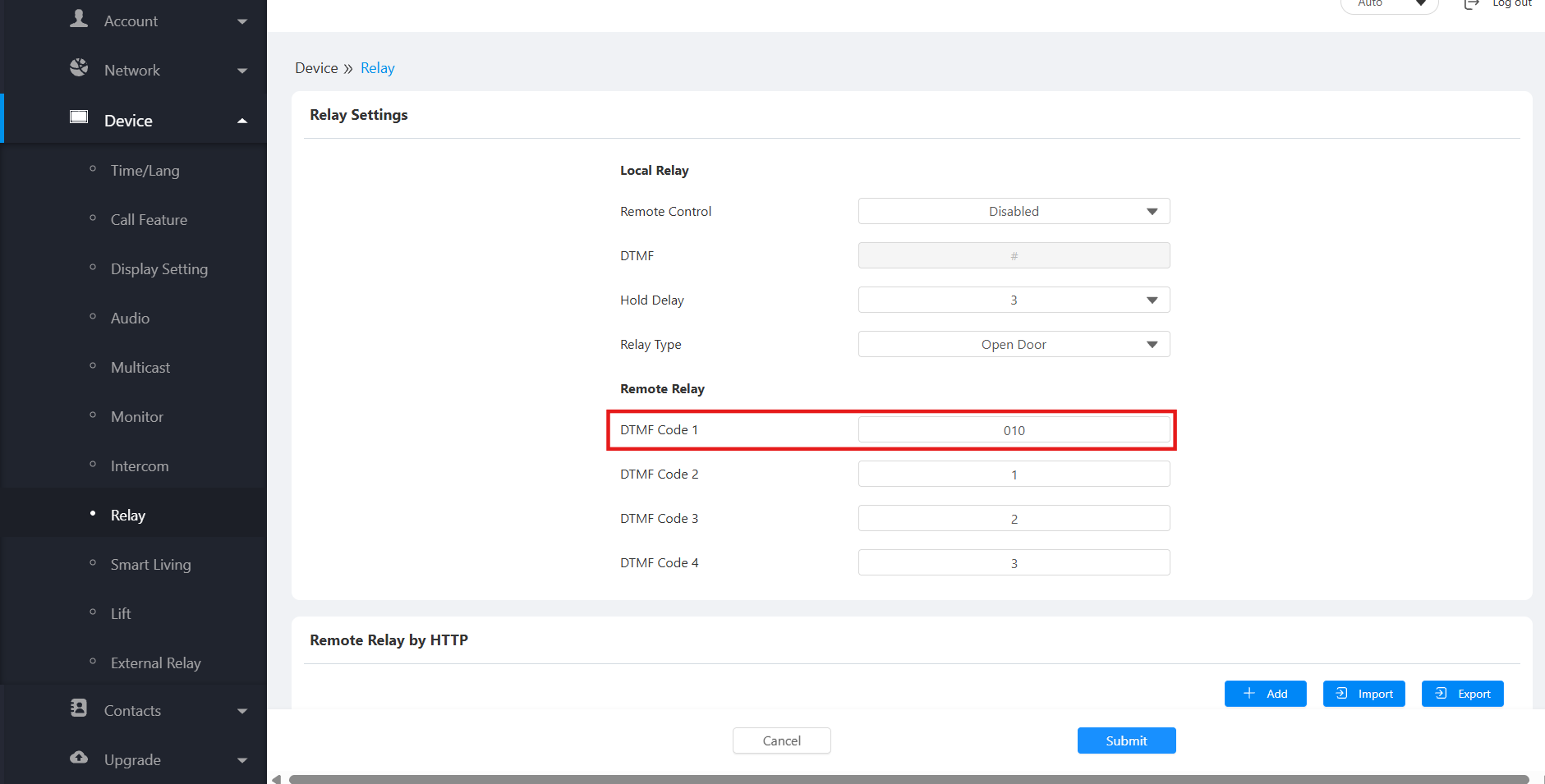
Navigate to Device > Relay > Relay Setting > Remote Relay interface.
Enter the DTMF code the same as that of the door phone in any of the code fields.
Click Submit.
After configuration, users can enter the DTMF code on the indoor monitor keypad during a call to trigger the Web Relay.
Trigger Web Relay by RF Cards
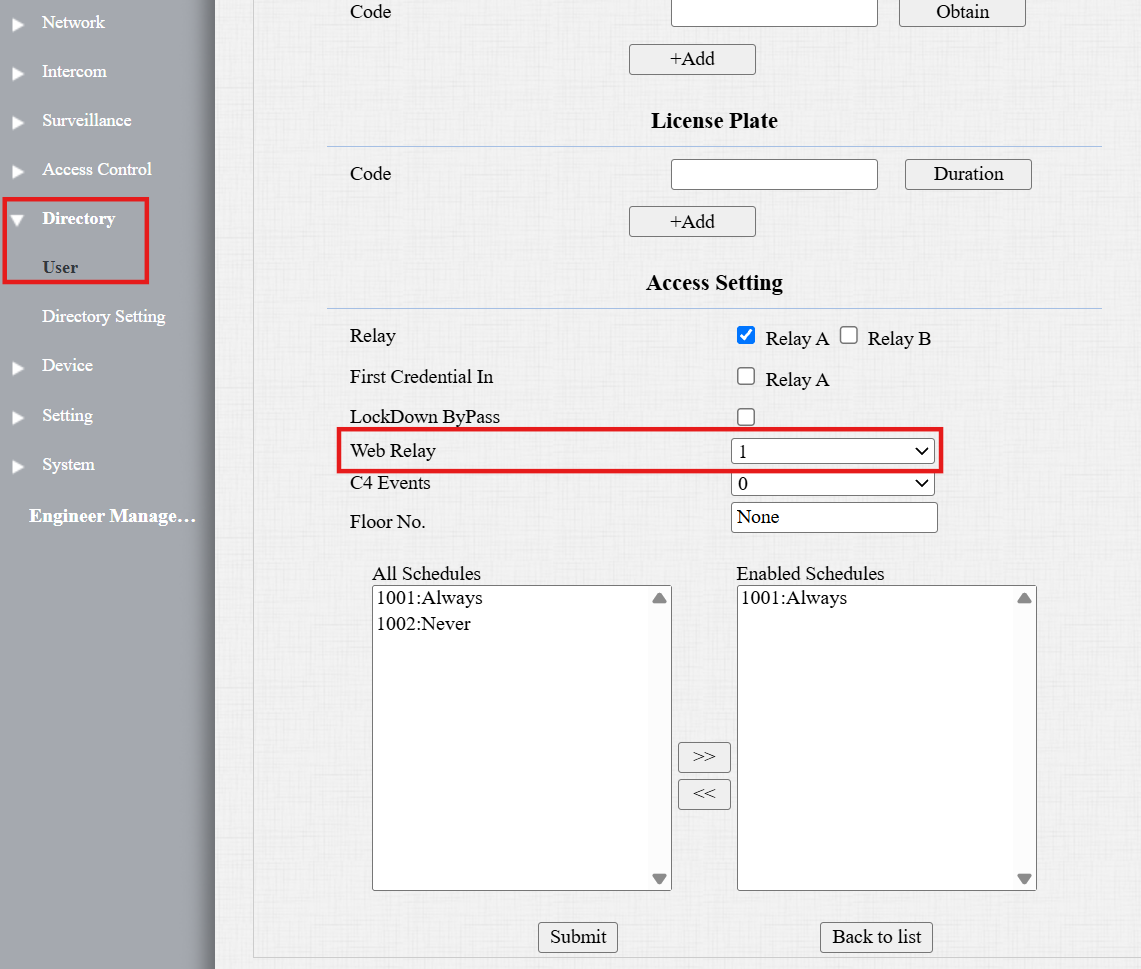
Navigate to the door phone’s Directory > User interface and click Add.
Enter the user name and select the user role.
Place the card on the device card reader and click Obtain to acquire the card code.
Select the web relay number according to the Web Relay Action ID. Only one web relay can be selected.
Click Submit to save the configuration.
After configuration, users can swipe the RF card on the door phone to trigger the Web Relay.
Trigger Web Relay via Cloud Configuration
When the device is deployed on the SmartPlus Cloud, you can set up the Web Relay Action ID on the Cloud when adding or editing an apartment.
Note
The following models support Web Relay ID synchronization from the Cloud:
X915 V2, X910, R29, R28 V2.0, X916, S539, S538, S535, S532, X912, R20 V5.0, A094/A092, A01/A02, A03, A05 V2, A08, A15, and A095
E18 (firmware 18.30.10.236 or later)
E16 V2 (firmware 216.30.11.3 or later)
E16 V3(firmware 416.30.11.206 or later)
E12 (firmware 312.30.10.237 or later)
R25 (firmware 25.30.10.117 or later)
Log in to the SmartPlus Cloud platform with an installer account.
On the Sites module, go to the target community by clicking
 .
.
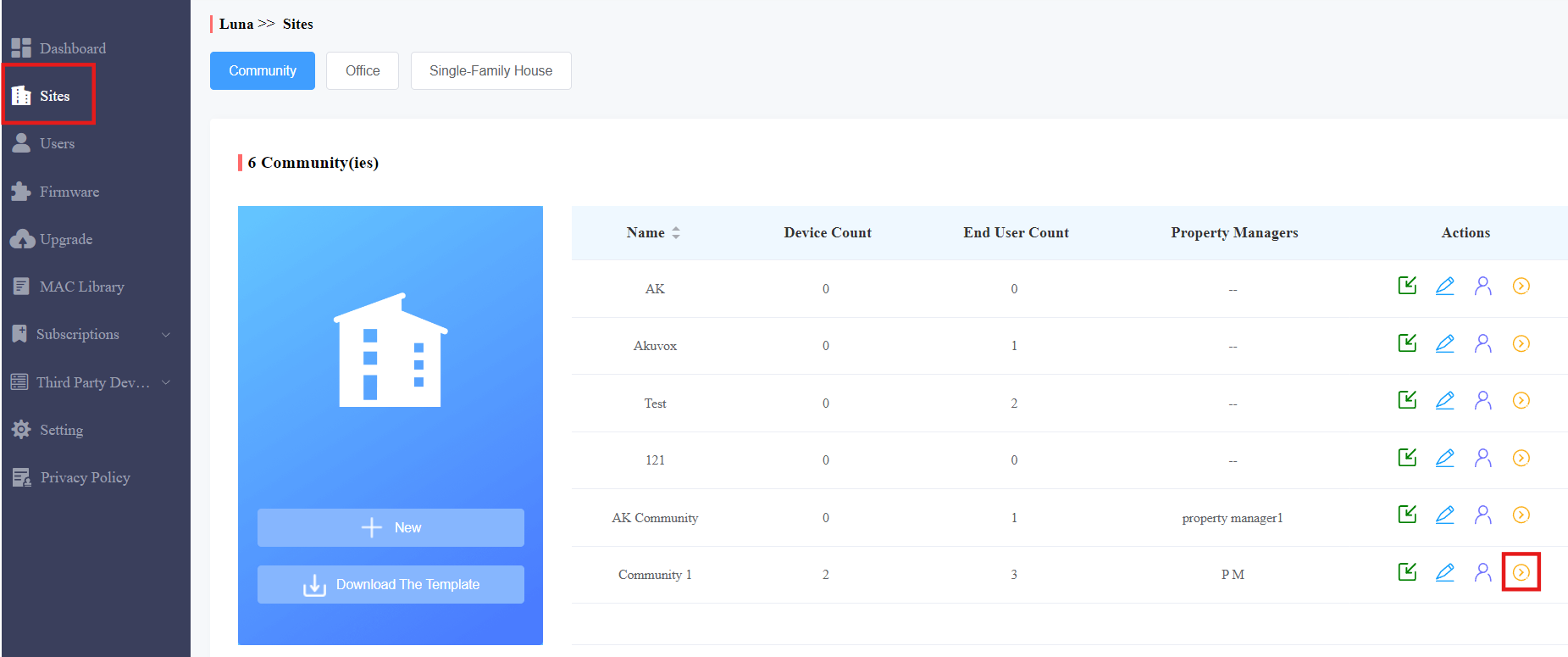
Click New to add an apartment or click
 to modify one.
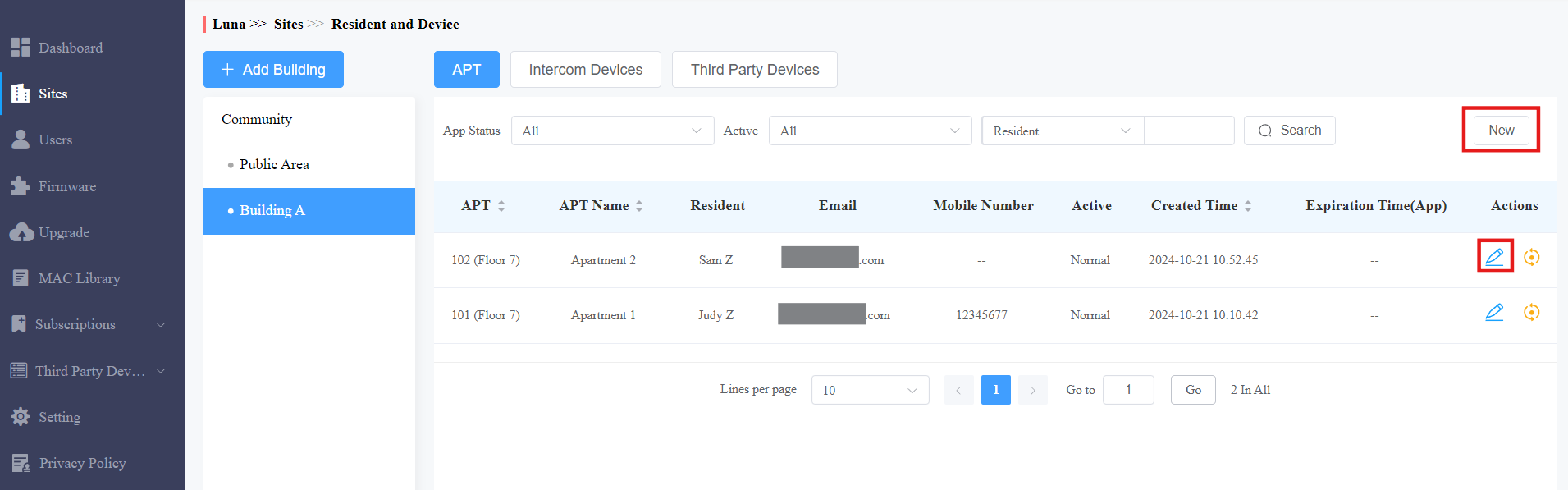
Find and select the Web Relay ID. Please note that one apartment can only have one web relay.
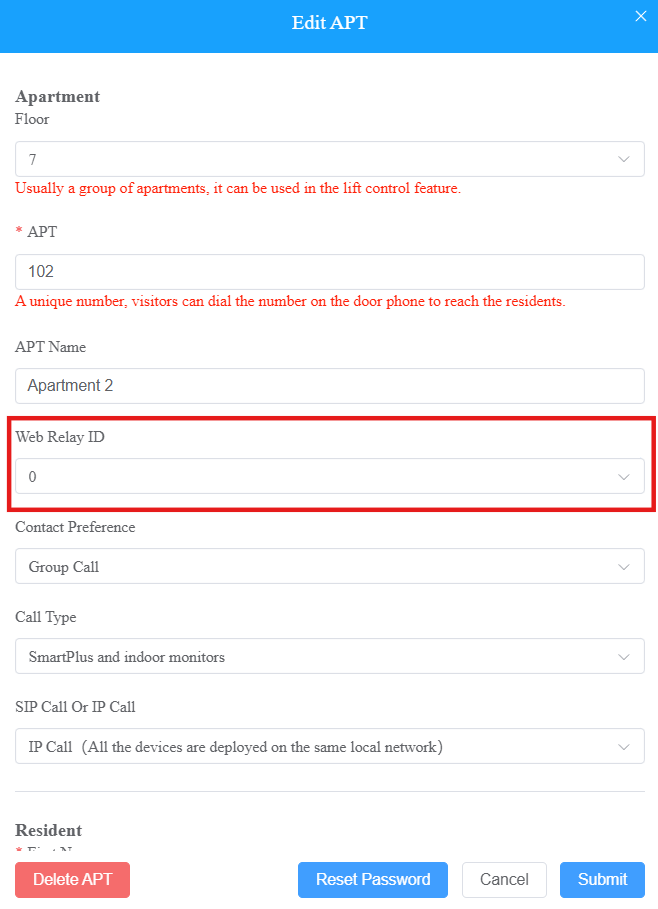
Click Submit to save the settings.
After configuration, users can trigger the Web Relay when using SmartPlus Cloud-based door-opening credentials.
Note
ONLY Android door phones(S539, S538, X916, X915V2, and R29) support triggering the web relay via the SmartPlus App(unlocking on the homepage or monitoring page).
Since version 205.30.10.203, A05V2 supports unlocking the web relay on SmartPlus’s homepage.