The device can be connected to the Akuvox lift controller for the lift control. Users can summon the lift to go down to the ground floor when they are granted access through various types of access methods on the device.
Click here to watch a demonstration video of configuring the lift control feature.
Set it up on the Device > Lift Control interface.
Lift Control List: Select the lift controller brand.
None: The integration will be disabled.
OSDP: Integrate with OSDP lift controller.
Dahua: Integrate with Dahua lift controller.
KeyKing: Integrate with KeyKing lift controller.
Akuvox: Connect the device with the Akuvox EC33 lift controller.
ZKT: Integrate with ZKTeco lift controller.
KONE: Integrate with KONE lift controller.
Note
When connecting the door phone to the lift controller via the RS485 ports, you need to select the right RS485 mode on the Device > RS485 interface.
Akuvox Lift Controller
After selecting Akuvox in the Lift Control List, you need to set up relevant parameters.
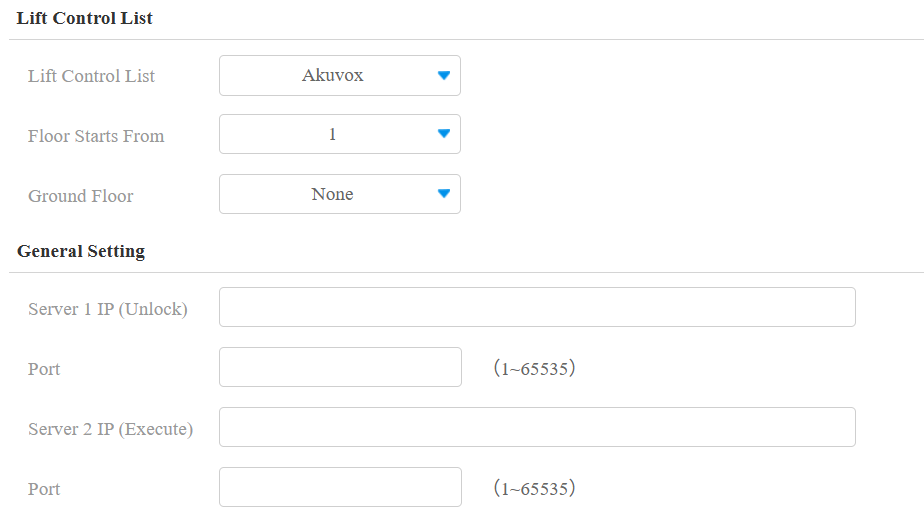
Floor Starts From: Set the floor from which the floor count starts. For example, if you select -3, then the 3rd floor in the basement will be considered as the first floor, matched with relay#1 (first floor).
Ground Floor: If there are ground floors between the -1 and 1 floors, configure this option.
Server 1 IP(Unlock): The IP address of the lift controller that unlocks the elevator button(s). It supports up to 10 server addresses separated by ";".
Server 2 IP(Execute): The IP address of the lift controller that sends the lift control commands.
Port: The server port of the lift controller server.
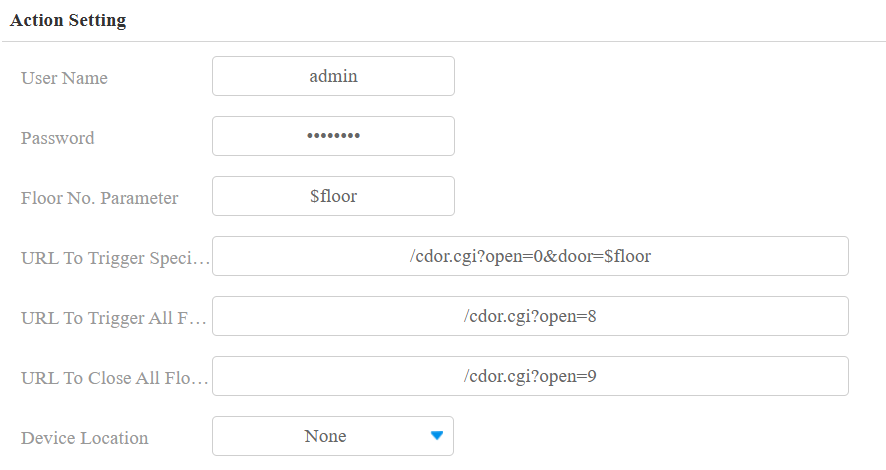
User Name: The username of the lift controller for the authentication.
Password: The password of the lift controller for the authentication.
Floor NO. Parameter: Enter the floor number parameter provided by Akuvox. The default parameter string is “$floor”. You can define your parameter string if needed.
URL To Trigger Specific Floor: Enter the Akuvox lift control URL for triggering a specific floor. The URL is /cdor.cgi?open=0&door=$floor, but the string “$floor” at the end must be identical to the parameter string you defined.
URL To Trigger All Floors: Enter the Akuvox URL for triggering all floors.
URL To Close All Floors: Enter the Akuvox URL used for closing all floors, meaning all the buttons that are triggered for the corresponding floors will become invalid.
Floor Starts From: Set the floor from which the floor count starts. for example, if you select -3, then the 3rd floor in the basement will be considered as the first floor matched with relay#1 (first floor).
Device Location: Select the floor where the device is installed.
KeyKing Lift Controller
After selecting KeyKing, you need to set the KeyKing address.
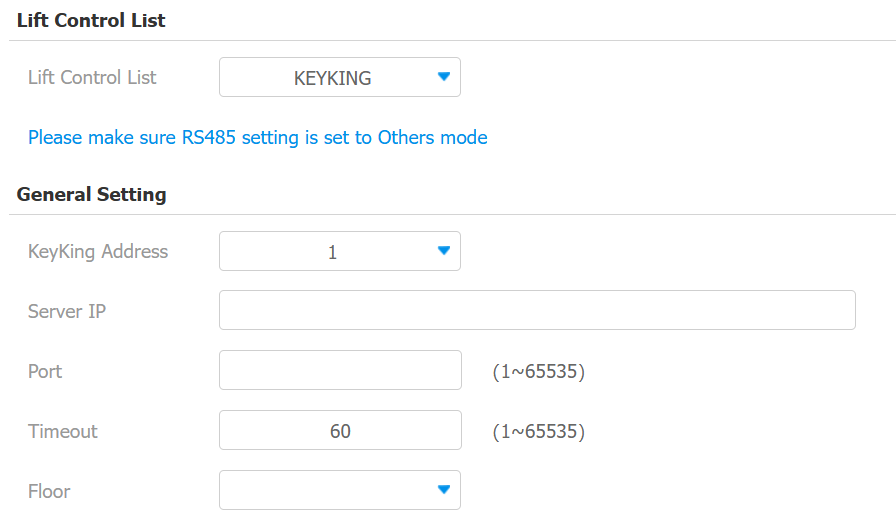
KeyKing Address: When the door phone works with the lift controller via RS485, select the number from 0 to 126. The binary number converted from the address number corresponds to the dip switch on the lift board. For example, if you select 5, set the dip switch to 101000.
Server IP: When the door phone works with the lift controller via TCP/IP, enter the correct IP address.
Port: Enter the port.
Timeout: The default is 60.
Floor: The lift will first go to the floor selected to pick up the user. Then, it will take the user to the designated floor based on their card or password.
ZKT Lift Controller
After selecting ZKT, you need to set up relevant parameters.
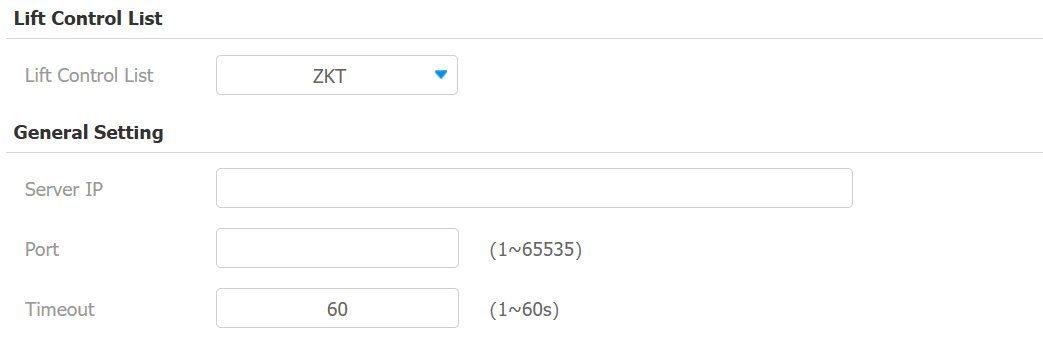
Server IP: Enter the IP address of the controller server.
Port: Enter the port of the controller server.
Timeout: Decide the time limit within which users should press the lift button of their desired floors.
KONE Lift Controller
The device supports the integration with the KONE lift control panel. Users can use their credentials configured on the door phone to unlock the lift button and access the desired floor.
Click the following articles to view the detailed configuration steps and different integration scenarios.
Set it up on the Device > Lift Control interface. Select KONE in the Lift Control List.
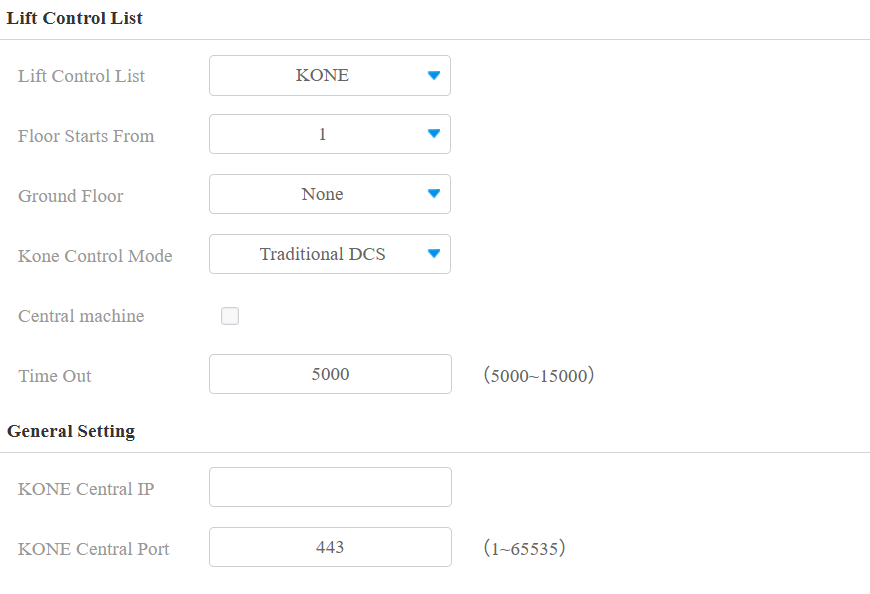
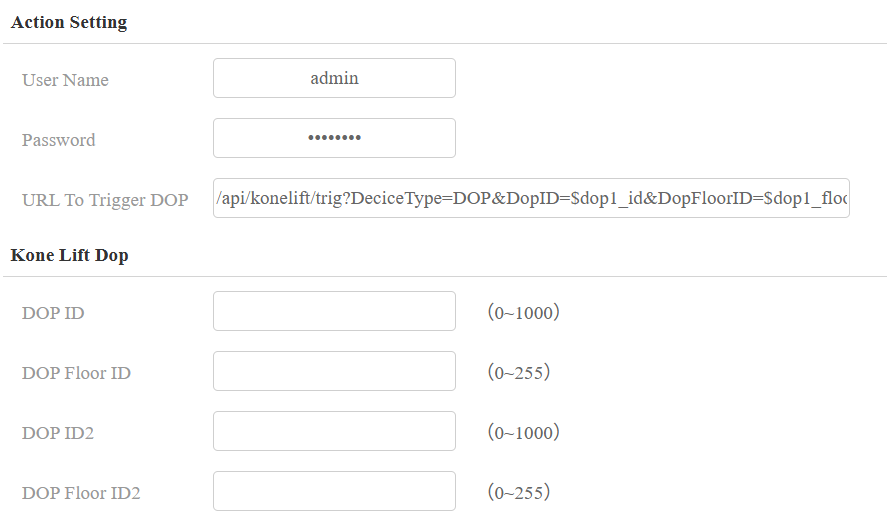
Floor Starts From: Set the floor from which the floor count starts. For example, if you select -3, then the 3rd floor in the basement will be considered as the first floor, matched with relay#1 (first floor).
Ground Floor: If there are ground floors between the -1 and 1 floors, configure this option.
KONE Control Mode: Select the option based on the lift control scenario.
Traditional DCS: The destination operating panels are on all floors, and there are no buttons on the car operating panel.
Conventional: Passengers select their destination floors on the control panel inside the lift car.
Hybrid DCS: The destination operating panels are located only on the main floors, while other floors have conventional landing signalization. Cars have a conventional operating panel.
Turnstile Integration: Passengers use their credentials at the entrance and call the lift.
Central Machine:
When the door phone is used as the central machine, configure the following options.
KONE Group Control IP/IP2: The KONE control panel’s IP address. You can enter three IPs for each group, separated by “;”.
Kone Group Control Port: The KONE control panel’s port number.
When the door phone is NOT used as the central machine, configure the following options.
KONE Central IP: The IP address of another door phone that is used as the central machine.
KONE Central Port: The port number of another door phone that is used as the central machine.
Username: The username of the HTTP API authentication set in the central machine.
Password: The password of the HTTP API authentication set in the central machine.
Time Out: Available for Traditional DCS, Conventional, and Hybrid DCS. It is 5000ms by default; define the time for users to press the lift button.
After choosing the KONE Control Mode, you need to fill in specific options. Please confirm them with the KONE service provider.
Kone Lift Dop | Kone Lift Cop | Lift Turnstile |
|---|---|---|
DOP ID | COP Elevator ID | Device Terminal ID |
DOP Floor ID | COP Group ID | Device Floor ID |
DOP ID2 | COP Elevator ID2 | Device Door |
DOP Floor ID2 | COP Group ID2 | Device Terminal ID2 |
Device Floor ID2 | ||
Device Floor ID2 |
KONE Mask Type: Available when the Central Machine is checked. Upload the default or specific mask file. To obtain the configuration file, please contact the Akuvox tech team.
OSDP Setting
After selecting OSDP, you need to set up relevant parameters.
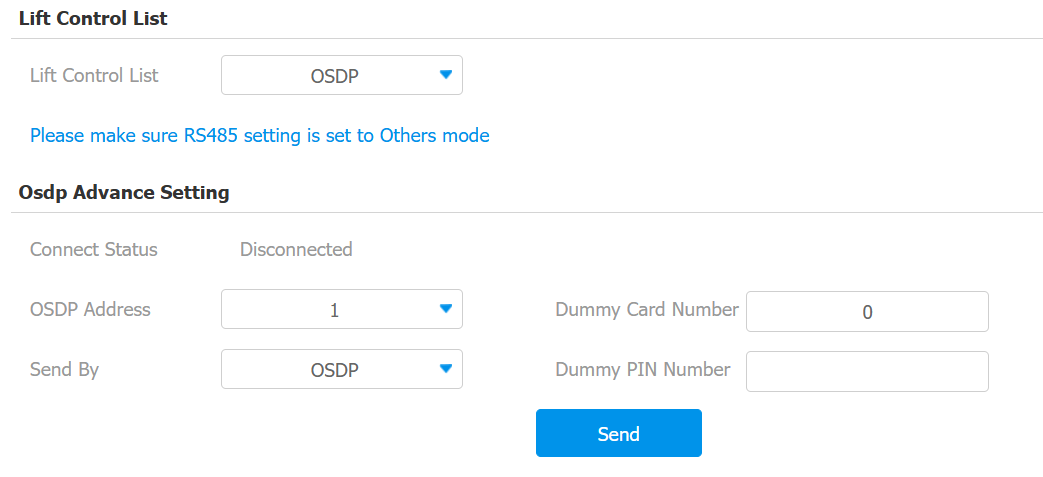
Connect Status: Indicate OSDP-based communication status.
OSDP Address: Obtain the specific OSDP address from the service provider.
Dummy Card Number: Enter the card number to obtain authentication by third-party devices such as opening the lift door, closing the door, or other forms of door access, etc.
Dummy PIN Number: Enter the PIN code to obtain authentication from third-party devices such as opening the lift door, closing the door, and so on.
Send by: Select in what way you want to send out the card number among three options: OSDP, Wiegand, and None. If you select OSDP then the card number will be sent out to the third-party devices via RS485. If you select Wiegand then the card number will be sent out via Wiegand. If you select None then the card number will not be sent out but retained in the system.