Device Network Status
To check network status, navigate to the web Status > Basic interface.
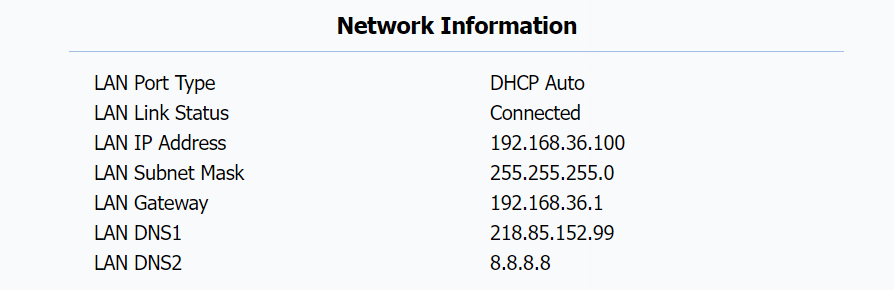
To check the network status on the device, navigate to the Settings > Status Info > Network Status screen.
(2).png "image(719)(2).png")
Device Network Configuration
To ensure normal functioning, make sure that the device has its IP address set correctly or obtained automatically from the DHCP server.
Set it up on the web Network > Basic interface.
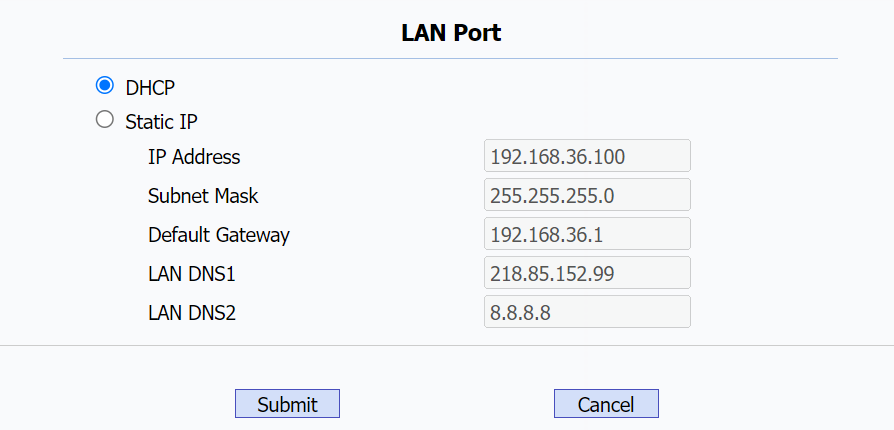
DHCP: DHCP mode is the default network connection. If the DHCP mode is selected, the device will be assigned by the DHCP server with an IP address, subnet mask, default gateway, and DNS server address automatically.
Static IP: When static IP mode is selected, the IP address, subnet mask, default gateway, and DNS server address should be configured according to the network environment.
IP Address: Set up the IP address when the static IP mode is selected. To access the device’s web settings, your computer should be on the same local network as the device.
Subnet Mask: A subnet mask tells your device which IP addresses are part of your local network and which ones are not. For example, if the subnet mask is 255.255.255.0, it means that devices with similar starting IPs (like 192.168.1.x) are in the same network.
Default Gateway: The gateway is like a bridge between your device and other networks, such as the internet. Usually, it’s the IP address of your router.
LAN DNS1/2: Domain Name System(DNS) is the overall system or network that handles the translation of domain names (like www.example.com) into IP addresses (like 192.0.2.1), which computers use to identify each other on a network. The device connects to the alternate DNS server when the primary one is unavailable.
The device network can also be configured on the Settings > Network Settings screen.
(1).png "image(721)(1).png")
Device Deployment in Network
To facilitate device control and management, configure Akuvox intercom devices with details such as location, operation mode, address, and extension numbers.
Set it up on the web Network > Advanced interface.
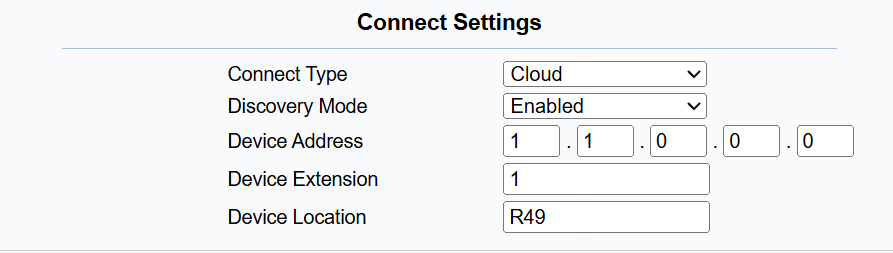
Connect Type: It is automatically set up according to the device connection with a specific server in the network, such as SDMC, Cloud, or None. You can also select it manually.
None: None is the default factory setting, indicating the device is not in any server type. Devices connect directly to each other or within a local area network (LAN) without relying on external servers.
Cloud: The device is connected to the SmartPlus Cloud, a cloud-based system simplifying property access management. The Cloud mode allows devices to interact intelligently with one another and the mobile SmartPlus App, backing up data daily and on different hosts. It suits projects requiring smart, flexible, and secure deployment and management.
SDMC: The device is connected to the SDMC, a management platform designed for on-premise projects. The SDMC mode manages and backs up data remotely on a local network. It also boasts many features suitable for projects requiring high privacy, lower cost, and centralized management.
Discovery Mode: Enabled by default. Available for the None server mode. The device can be discovered by other devices in the network. When disabled, the device will be concealed and not be discovered by other devices.
Device Address: Available for the None server mode. It can be used to call the device. Specify the device address by entering device location information from left to right: Community, Building, Unit, Floor, and Room in sequence.
Device Extension: Available for the None server mode. The device extension number ranges from 0 to 10.
Device Location: The location where the device is installed and used.
Wi-Fi Connection
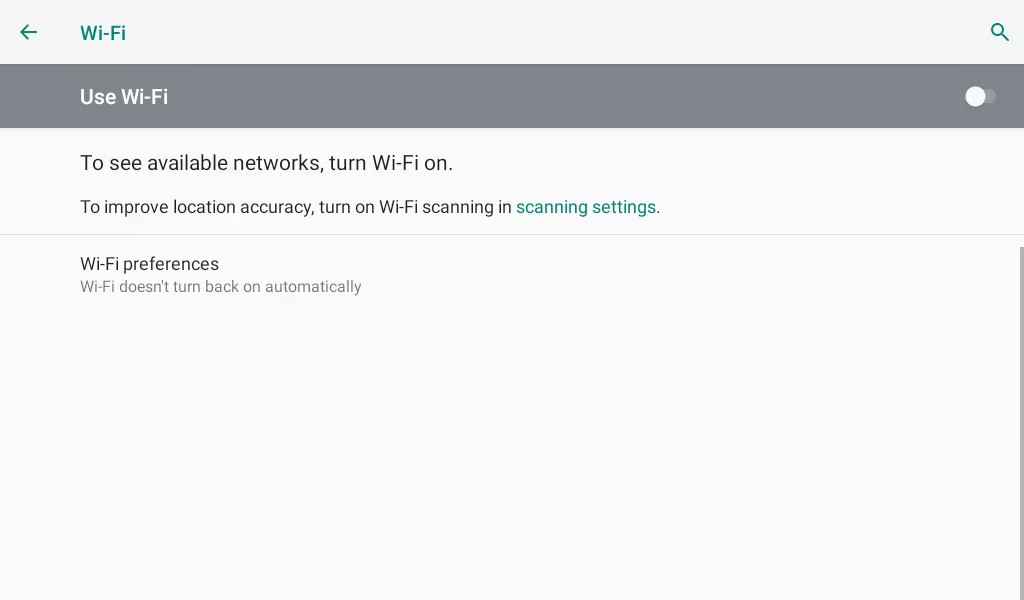
In addition to a wired connection, the device also supports a Wi-Fi connection. Slide down on the home screen and long-press on the Wi-Fi icon to enter the settings screen.
(1).png "image(726)(1).png")
Local RTP Configuration
Real-time Transport Protocol(RTP) lets devices stream audio and video data over a network in real time.
To use RTP, devices need a range of ports. A port is like a channel for data on a network. By setting up RTP ports on your device and router, you can avoid network interference and improve audio and video quality.
Set it up on the web Network > Advanced interface.

Min RTP Port: The port value to establish the start point for the exclusive data transmission range.
Max RTP port: The port value to establish the endpoint for the exclusive data transmission range.
Bluetooth Configuration
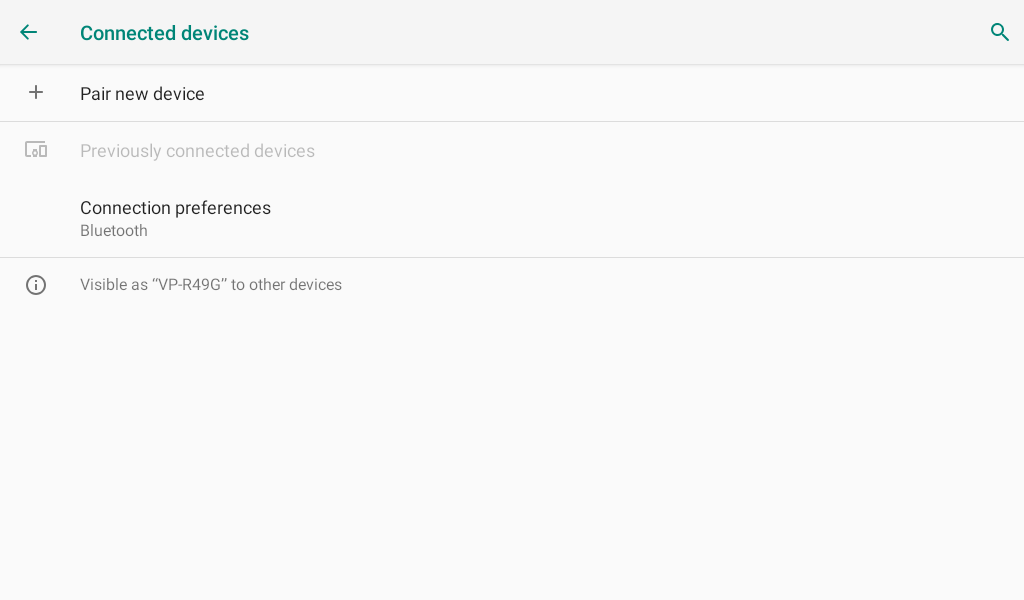
To connect via Bluetooth, enable the Bluetooth function on the device to establish connections with other Bluetooth-enabled devices for file transfer and calls. Slide down on the home screen and long-press the Bluetooth icon to access the settings.
Tap Pair new device to establish connections.
Device VLAN Configuration
A Virtual Local Area Network (VLAN) is a logical group of nodes from the same IP domain, regardless of their physical network segment. It separates the layer 2 broadcast domain via switches or routers, sending tagged packets only to ports with matching VLAN IDs. Utilizing VLANs enhances security by limiting ARP attacks to specific hosts and improves network performance by minimizing unnecessary broadcast frames, thereby conserving bandwidth for increased efficiency.
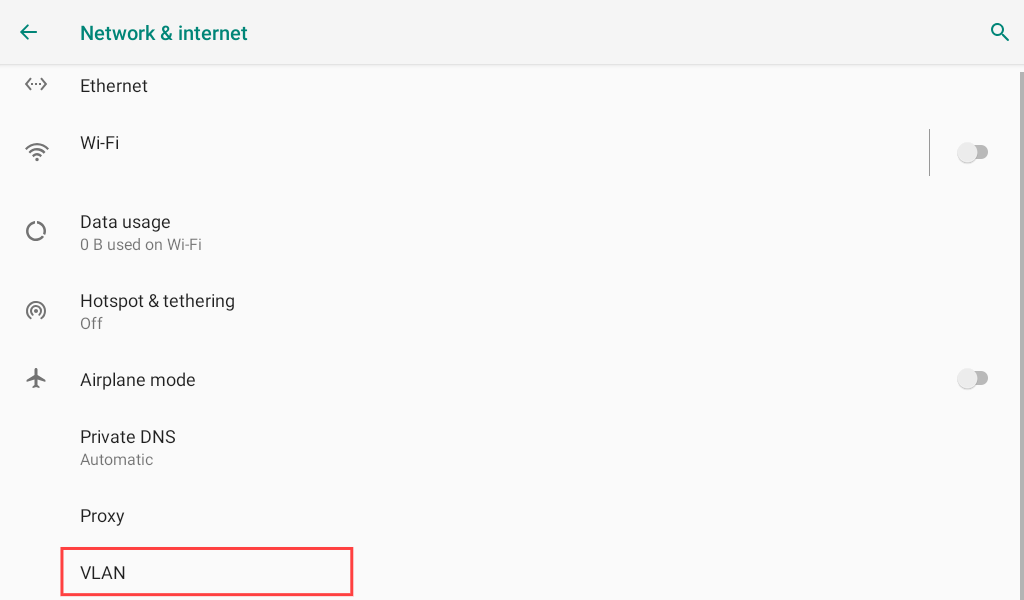
Tap  > Settings > Network & Internet > VLAN on the device screen.
(1).png "image(734)(1).png")
PC Port Setting: Enable it to connect the device to the VLAN network from the PC port on the device. R49 has two types of ports for the network connection: one is the PC port and the other is the LAN port. If you set the PC port for the VLAN network connection and connect the device to the network from the device's LAN port, then the setting will not be valid. The value is 0 by default.
PC Port Priority: Select the PC port priority from 0-9. The higher the number is, the higher priority will be given to the VLAN in terms of sending out the data packets to the devices in the VLAN when network congestion occurs.
PC Port ID (1-4095): This parameter does not need to be filled in by the users. The ID is 1 by default.
LAN Port Setting: Enable it to connect the device to the VLAN network from the LAN port on the device. R49 has two types of ports for the network connection: one is the PC port and the other is the LAN port. If you set the LAN port for the VLAN network connection and connect the device to the network from the device's PC port, the setting will not be valid. The value is 0 by default.
LAN Port Priority: Select the PC port priority from 0-9. The higher the number is, the higher priority will be given to the VLAN in terms of sending out the data packets to the devices in the VLAN when network congestion occurs.
LAN Port ID (1-4095): Leave this field blank, as this parameter does not need to be filled in by the users. The ID is 1 by default.