To ensure normal functioning, make sure that the device has its IP address set correctly or obtained automatically from the DHCP server.
To set it up, go to Network > Basic interface.
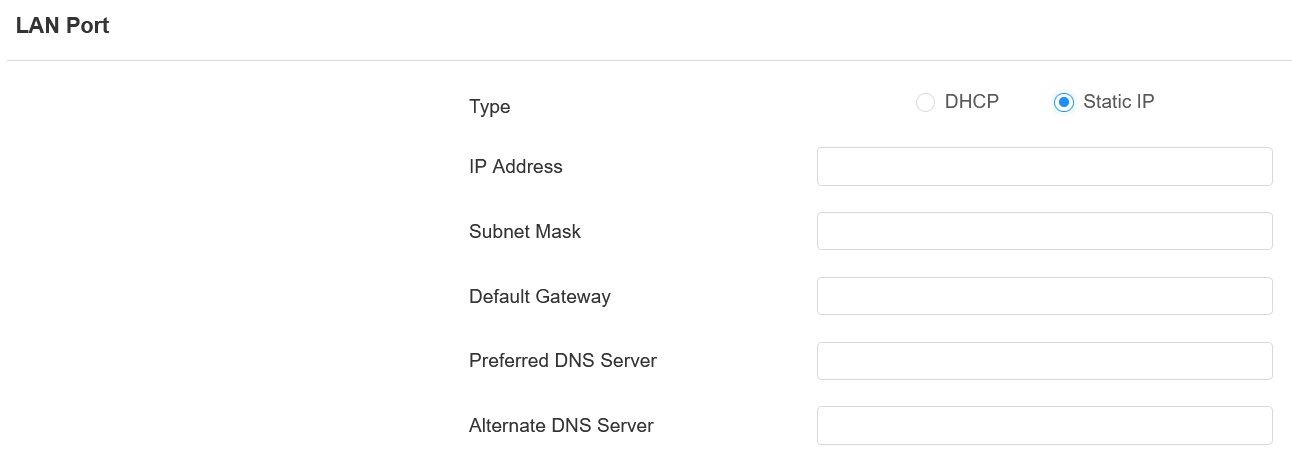
DHCP: DHCP mode is the default network connection. If the DHCP mode is selected, then the device will be assigned by the DHCP server with an IP address, subnet mask, default gateway, and DNS server address automatically.
Static IP: When static IP mode is selected, the IP address, subnet mask, default gateway, and DNS server address have to be manually configured according to the actual network environment.
IP Address: Set up the IP address when the static IP mode is selected. To access the device’s web settings with the IP, your computer should be on the same local network as the device.
Subnet Mask: A subnet mask tells your device which IP addresses are part of your local network and which ones are not. For example, if the subnet mask is 255.255.255.0, it means that devices with similar starting IPs (like 192.168.1.x) are in the same network.
Default Gateway: The gateway is like a bridge between your device and other networks, such as the internet. Usually, it’s the IP address of your router.
Preferred/Alternate DNS Server: Set up the preferred or alternate Domain Name System(DNS) server according to the actual network environment. The preferred DNS server is the primary server, while the alternate DNS server is the secondary one. The secondary server is for backup.
SNMP Setting
Simple Network Management Protocol(SNMP) is a protocol for managing IP network devices. It allows network administrators to monitor devices and receive alerts for attention-worthy conditions. SNMP provides variables describing system configuration, organized in hierarchies and described by Management Information Bases (MIBs).
To set it up, go to the Network > Advanced interface.

SNMP Port: Set a specific port for the data transmission from 1024-65535.
Trusted IP: Enter the third-party IP address.
Web HTTP Setting
This function manages device website access. The device supports two remote access methods: HTTP and HTTPS (encryption).
To set it up, go to the Network > Advanced interface.

HTTP Redirect: When enabled, the device’s web settings can be accessed via HTTP protocol. When disabled, it will be redirected to the HTTPS. This setting is also effective for the HTTP API feature.
VLAN Setting
A Virtual Local Area Network (VLAN) is a logical group of nodes from the same IP domain, regardless of their physical network segment. It separates the layer 2 broadcast domain via switches or routers, sending tagged packets only to ports with matching VLAN IDs. Utilizing VLANs enhances security by limiting ARP attacks to specific hosts and improves network performance by minimizing unnecessary broadcast frames, thereby conserving bandwidth for increased efficiency.
To set it up, go to the Network > Advanced interface.

Priority: The VLAN priority for the designated port.
VLAN ID: The VLAN ID for the designated port.