Network Status
Check the network status on the web Status > Info > Network Information interface.
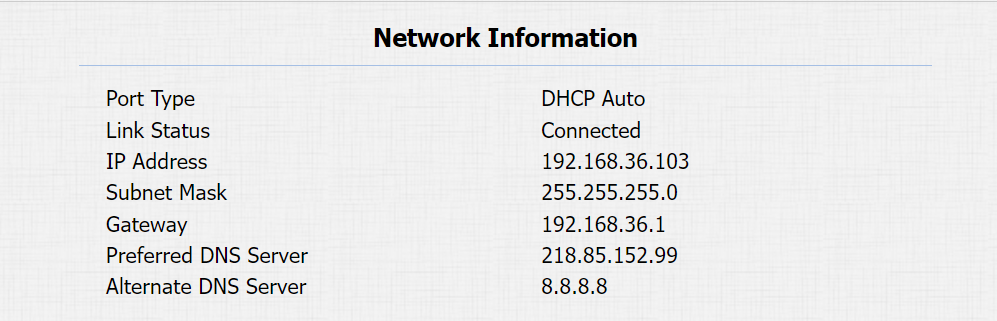
Device Network Configuration
To ensure normal functioning, make sure that the device has its IP address set correctly or obtained automatically from the DHCP server.
To set it up, go to the Network > Basic interface.
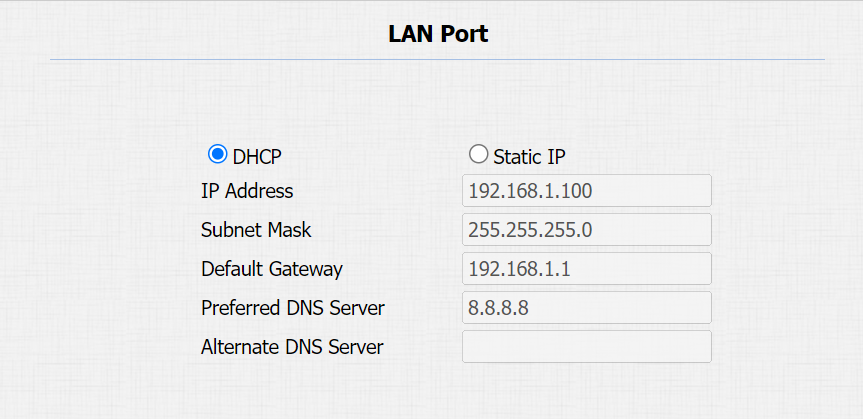
DHCP: DHCP mode is the default network connection. If the DHCP mode is turned on, the device will automatically be assigned by the DHCP server with an IP address, subnet mask, default gateway, and DNS server address.
Static IP: The IP address, subnet mask, default gateway, and DNS server address have to be manually configured according to the actual network environment.
IP Address: Set up the IP address when the static IP mode is selected. To access the device’s web settings, your computer should be on the same local network as the device.
Subnet Mask: A subnet mask tells your device which IP addresses are part of your local network and which ones are not. For example, if the subnet mask is 255.255.255.0, it means that devices with similar starting IPs (like 192.168.1.x) are in the same network.
Default Gateway: The gateway is like a bridge between your device and other networks, such as the internet. Usually, it’s the IP address of your router.
Preferred & Alternate DNS Server: Domain Name System(DNS) is the overall system or network that handles the translation of domain names (like www.example.com) into IP addresses (like 192.0.2.1), which computers use to identify each other on a network. The door phone connects to the alternate DNS server when the primary one is unavailable.
Device Deployment in Network
To facilitate device control and management, configure Akuvox intercom devices with details such as location, operation mode, address, and extension numbers.
To set it up, go to the Network > Advanced > Connect Setting interface.
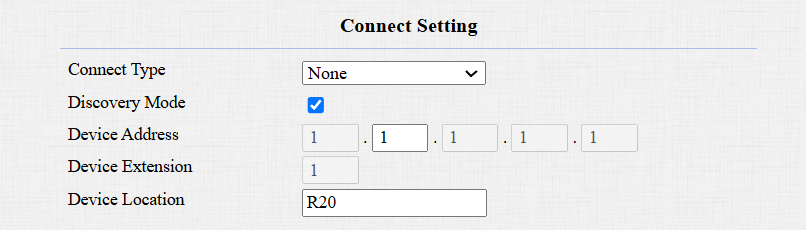
Connect Type: It is automatically set up according to the actual device connection with a specific server in the network, such as SDMC, Cloud, or None. You can also select the type manually.
None: None is the default factory setting, indicating the device is not in any server type. Devices connect directly to each other or within a local area network (LAN) without relying on external servers.
Cloud: The device is connected to the SmartPlus Cloud, a cloud-based system simplifying property access management. The Cloud mode allows devices to interact intelligently with one another and the mobile SmartPlus App, backing up data daily and on different hosts. It suits projects requiring smart, flexible, and secure deployment and management.
SDMC: The device is connected to the SDMC, a management platform designed for on-premise projects. The SDMC mode manages and backs up data remotely on a local network. It also boasts many features suitable for projects requiring high privacy, lower cost, and centralized management.
Discovery Mode: Enabled by default. Available for None server mode. The device can be discovered by other devices in the network. When disabled, the device will be concealed and not be discovered by other devices.
Device Address: Available for None server mode. Uneditable in Cloud and SDMC mode. It can be used to call the device. Specify the device address by entering device location information from the left to the right: Community, Building, Unit, Floor, and Room in sequence.
Device Extension: Available for None server mode. Uneditable in Cloud and SDMC mode. The device extension number ranges from 0 to 10.
Device Location: The location where the device is installed and used.
Device Local RTP Configuration
Real-time Transport Protocol(RTP) lets devices stream audio and video data over a network in real time.
To use RTP, devices need a range of ports. A port is like a channel for data on a network. By setting up RTP ports on your device and router, you can avoid network interference and improve audio and video quality.
To set it up, go to the Network > Advanced > Local RTP interface.

Starting RTP Port: The port value to establish the start point for the exclusive data transmission range.
Max RTP port: The port value to establish the endpoint for the exclusive data transmission range.
NAT Setting
Network Address Translation(NAT) lets devices on a private network use a single public IP address to access the internet or other public networks. NAT saves the limited public IP addresses and hides the internal IP addresses and ports from the outside world.
To register SIP accounts on third-party servers in a Wide Area Network(WAN), you need to enable the RPort feature on the intercom devices to establish a stable connection.
To set up NAT, navigate to the web Account > Basic > NAT interface.

Stun Server Address: Set the SIP server address in the Wide Area Network(WAN).
Port: Set the SIP server port.
Then set up NAT on the Account > Advanced > NAT interface.
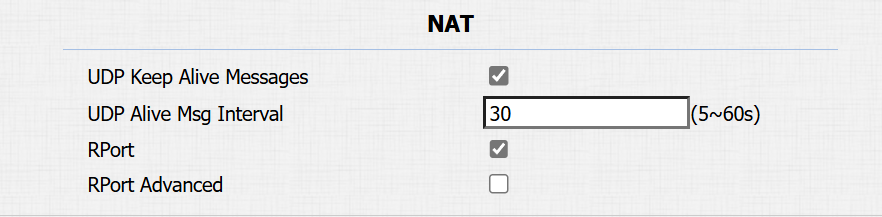
UDP Keep Alive Messages: If enabled, the device will send out the message to the SIP server so that the SIP server will recognize if the device is in online status.
UDP Alive Msg Interval: The message-sending time interval ranges from 5 to 60 seconds. The default is 30 seconds.
RPort: Enable the RPort when the SIP server is in the WAN.
RPort Advanced: Further stabilize the network based on RPort.
SNMP Setting
Simple Network Management Protocol(SNMP) is a protocol for managing IP network devices. It allows network administrators to monitor devices and receive alerts for attention-worthy conditions. SNMP provides variables describing system configuration, organized in hierarchies and described by Management Information Bases (MIBs).
To set it up, go to the Network > Advanced > SNMP interface.
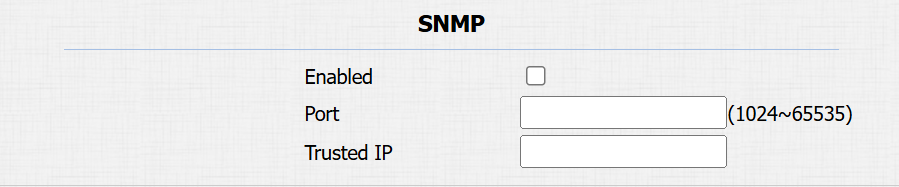
Trusted IP: The allowed SNMP server address. It can be an IP address or any valid URL domain name.
VLAN Setting
A Virtual Local Area Network (VLAN) is a logical group of nodes from the same IP domain, regardless of their physical network segment. It separates the layer 2 broadcast domain via switches or routers, sending tagged packets only to ports with matching VLAN IDs. Utilizing VLANs enhances security by limiting ARP attacks to specific hosts and improves network performance by minimizing unnecessary broadcast frames, thereby conserving bandwidth for increased efficiency.
To set it up, go to the Network > Advanced > VLAN interface.

VID: The VLAN ID for the designated port.
Priority: The VLAN priority for the designated port.
TR069 Setting
TR-069 (Technical Report 069) provides the communication between Customer-Premises Equipment (CPE) and Auto-Configuration Servers (ACS). It includes both a safe auto configuration and the control of other CPE management functions within an integrated framework. For door phones, the administrators can manage all the devices on a common TR-069 Platform. IP phones can be easily and securely configured on the TR-069 platform to make mass deployment more efficient.
To set it up, go to the Network > Advanced > TR069 interface.
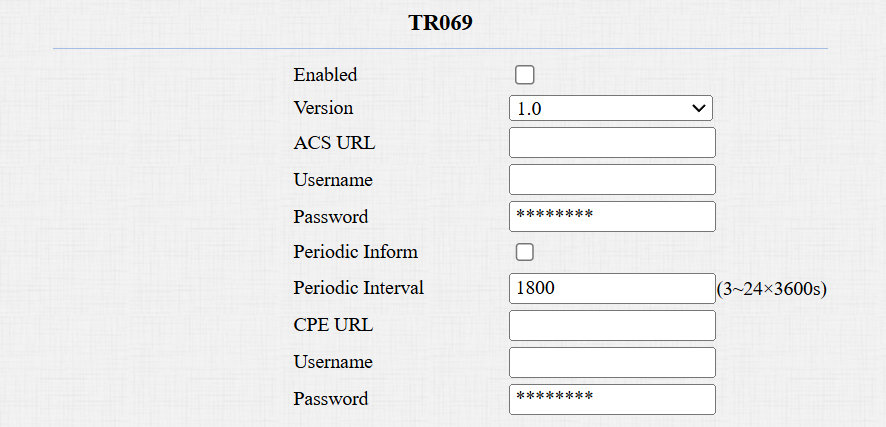
Version: Select the supported TR069 version (version 1.0 or 1.1).
ACS/CPE URL: ACS is short for auto-configuration servers on the server side, and CPE is short for customer-premise equipment, as client-side devices.
Periodic Interval: The interval for periodic notification.
Device Web HTTP Setting
This function manages device website access. The device supports two remote access methods: HTTP and HTTPS (encryption).
To set it up, go to the Network > Advanced > Web Server interface.
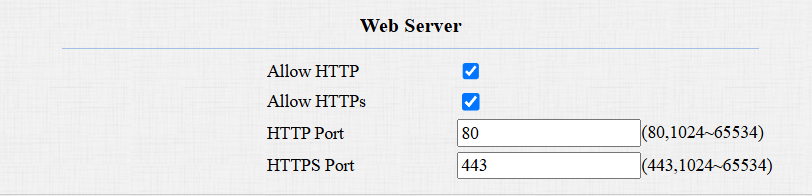
Allow HTTP/HTTPS: HTTP and HTTPS are enabled by default.
HTTP/HTTPS Port: Specify the web server port for accessing the device web interface via HTTP/HTTPS.
LTE Wireless Connection
The LTE module enables cellular network connectivity for the device in areas where wired networks are unavailable, particularly beneficial for installations in older buildings.
Only R20K-L has an LTE module, and the device firmware version should be 320.30.11.27 or higher.
Set this feature up on the Network > Advanced interface. It is enabled by default.
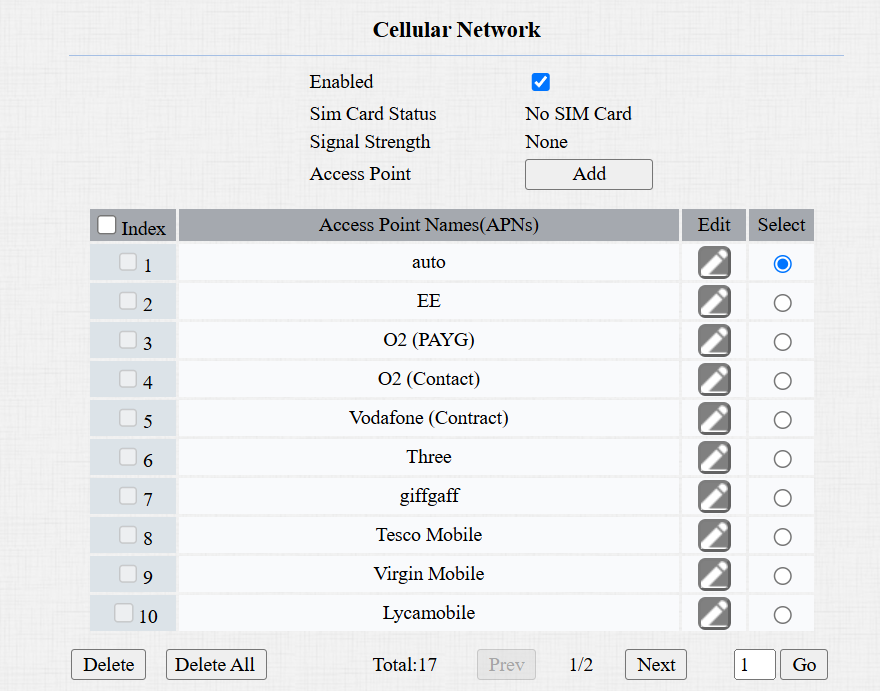
Enabled: The function is enabled by default.
SIM Card Status: Display whether a SIM card is inserted.
Signal Strength: Indicate the network connection.
None: No SIM card inserted or the SIM card is not properly inserted, unable to detect signal.
Weak: The network signal is poor, typically when the signal strength is below -100 dBm.
Fair: The network signal is average, usually when the signal strength is between -90 and -100 dBm.
Good: The network signal is good, generally when the signal strength is between -70 and -90 dBm.
Excellent: The network signal is excellent, typically when the signal strength is between -50 and -70 dBm.
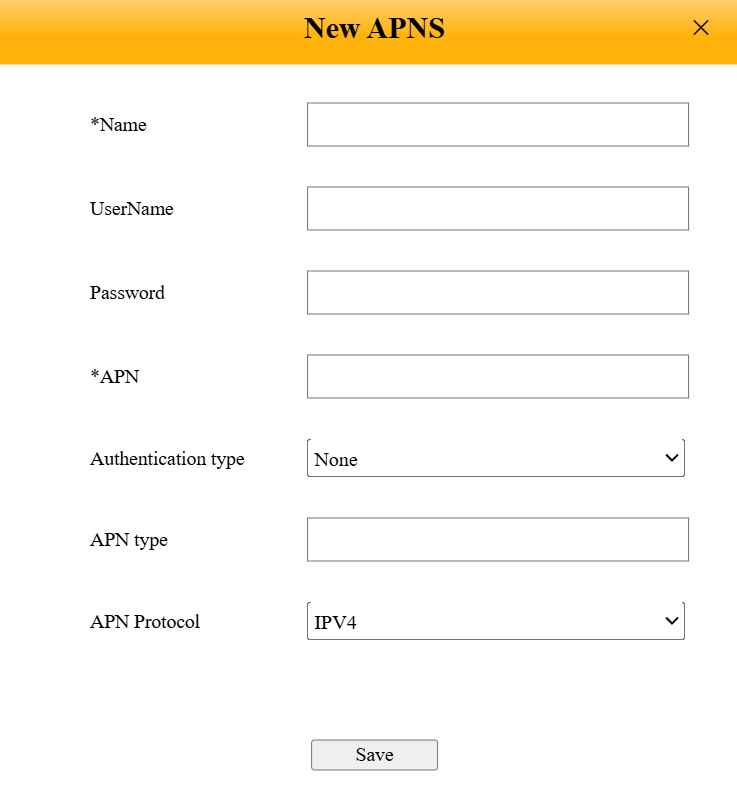
Access Point: Select the access point or click Add to add a new one.
Fill in the following information before clicking Save. These can be found from the network provider of your SIM card.
Note
To turn off the LTE function without logging in to the device web, tap “*1100#” on the device. Once disabled, the device will play “didi” sound and switch to DHCP mode. Make sure the device can access network after cutting off the LTE connection.
Bluetooth-based LTE Configuration via AK-Partner App
The R20K-L supports LTE configuration via the AK-Partner App over Bluetooth, allowing installers to set up cellular network parameters (e.g., APN) without logging into the web interface.
Click here to view the detailed configuration.
Enable the Bluetooth feature on the Access Control > BLE interface.

802.1X Setting
802.1X is a network access control protocol defined by the Institute of Electrical and Electronics Engineers (IEEE). It provides an authentication mechanism for devices wishing to connect to a LAN or WLAN.
The authentication process is as follows:
The 802.1X client sends an EAPOL-Start message.
The network device receives it and sends an EAP request.
The user device responds with an EAP response.
The authentication server verifies the credentials and sends an EAP success message.
The user device connects to the network and gains access.
Set this feature up on the Network > Advanced interface.

802.1x Mode: When the device is in the 802.1x environment,
Disabled: The device cannot access the external network. Static IP can be configured correctly, but DHCP fails to obtain an IP address.
EAP-MD5: The device actively initiates authentication.
Identity: The authentication username or account.
MD5 Password: EAP-MD5 authentication password.