This chapter introduces the key functions used to configure and monitor different detection scenarios of MR03, including person tracking, fall detection, sleep monitoring, and full-function modes.
Working Mode defines the overall detection capabilities of MR03, while Room Settings defines the overall detection space and Sub-regions define specific functional areas within that space.
Working Mode
Working Mode determines the detection capabilities enabled on MR03. After selecting a mode, only supported configuration items are displayed.
Select a working mode on the Fall Settings > General Settings interface.
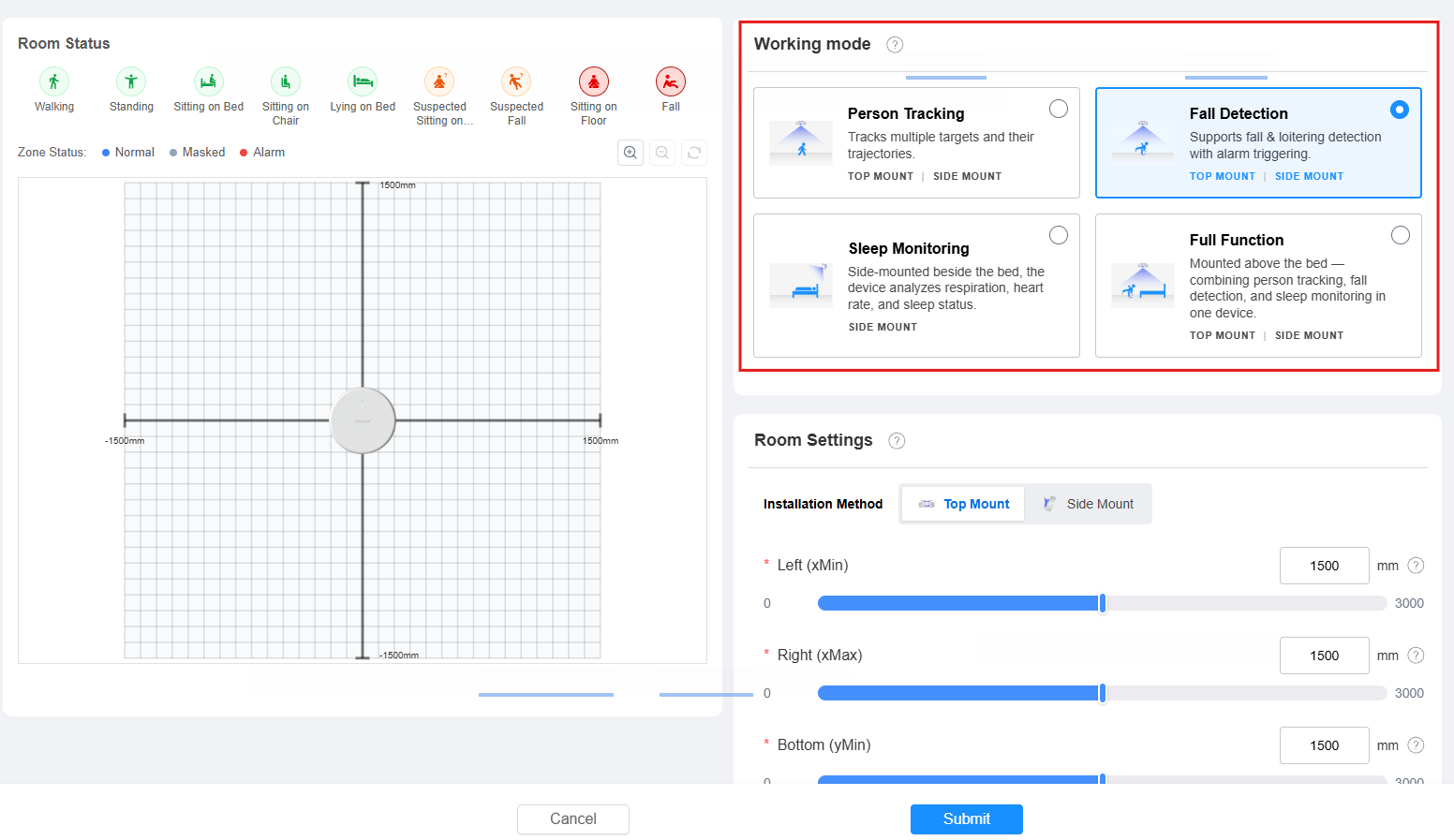
Person Tracking: Designed for scenarios requiring real-time monitoring of personnel positions and movements. This mode enables multi-person detection, position tracking, and trajectory monitoring within the detection area.
Fall Detection: The default mode. Designed for safety protection scenarios such as elderly care and emergency monitoring. This mode enables fall detection and sitting-on-floor detection.
Sleep Monitoring: Designed for healthcare and sleep monitoring scenarios. This mode focuses on bed-area monitoring and enables breathing rate and heart rate detection. This mode only supports side-mounted installation.
Full Function: Designed for scenarios requiring comprehensive monitoring capabilities. This mode enables all supported detection functions, including person tracking, fall detection, sleep monitoring, vital signs monitoring, and related alarm functions.
Room Settings
The Room Settings are required for all working modes.
You can define the overall detection area and installation parameters of the device, which determine the spatial scope for all detection functions.
Set it up on the Fall Settings > General Settings interface.
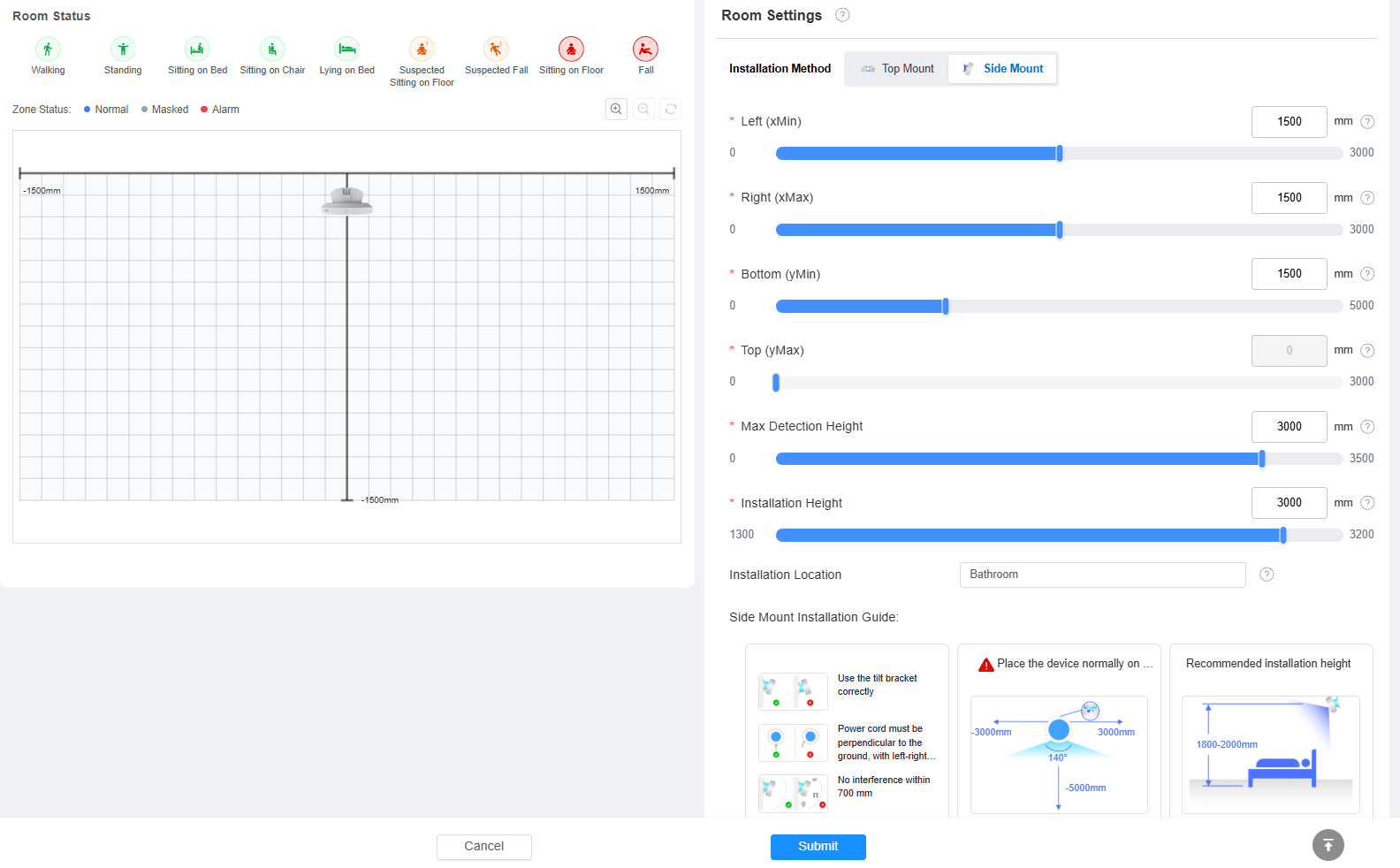
Installation Method: Specify how the device is mounted, which affects coordinate ranges and height constraints.
Top Mount: The device is mounted on the ceiling.
Side Mount: The device is mounted on a wall.
Coordinate System: Define the reference coordinate system used to describe the detection space, with the device as the center point.
Left(xMin): The minimum x-coordinate centered around MR03(0 to 3000). The default value is 1500.
Right(xMax): The maximum x-coordinate centered around MR03(0 to 3000). The default value is 1500.
Bottom(yMin): The minimum y-coordinate centered around MR03. The default value is 1500.
When selecting top-mounted, the value range is from 0 to 3000.
When selecting side-mounted, the value range is from 0 to 5000.
Top(yMax): The maximum y-coordinate centered around MR03(0 to 3000). The default value is 1500.
Max Detection Height: The height of the detection space. The default value is 3000.
Installation Height: The installation height of MR03.
When top-mounted, the installation height is the distance from the floor to the device plane. The default value is 3000, and the value range is from 1800 to 4000.
When side-mounted, the installation height is the distance from the floor to the center of the device. The default value is 3000, and the value range is from 1800 to 3200.
Installation Location: The installation location of MR03.
Height Rules:
Top Mount: Installation Height ≥ Max Detection Height
Side Mount: No restriction between Installation Height and Max Detection Height
Fall Detection Settings
When the device is in Fall Detection or Full Function working mode, you can configure the timing parameters used to confirm and report fall events, and the sitting-on-floor detection.
Set them up on the Fall Settings > General Settings > Fall Detection Settings interface.
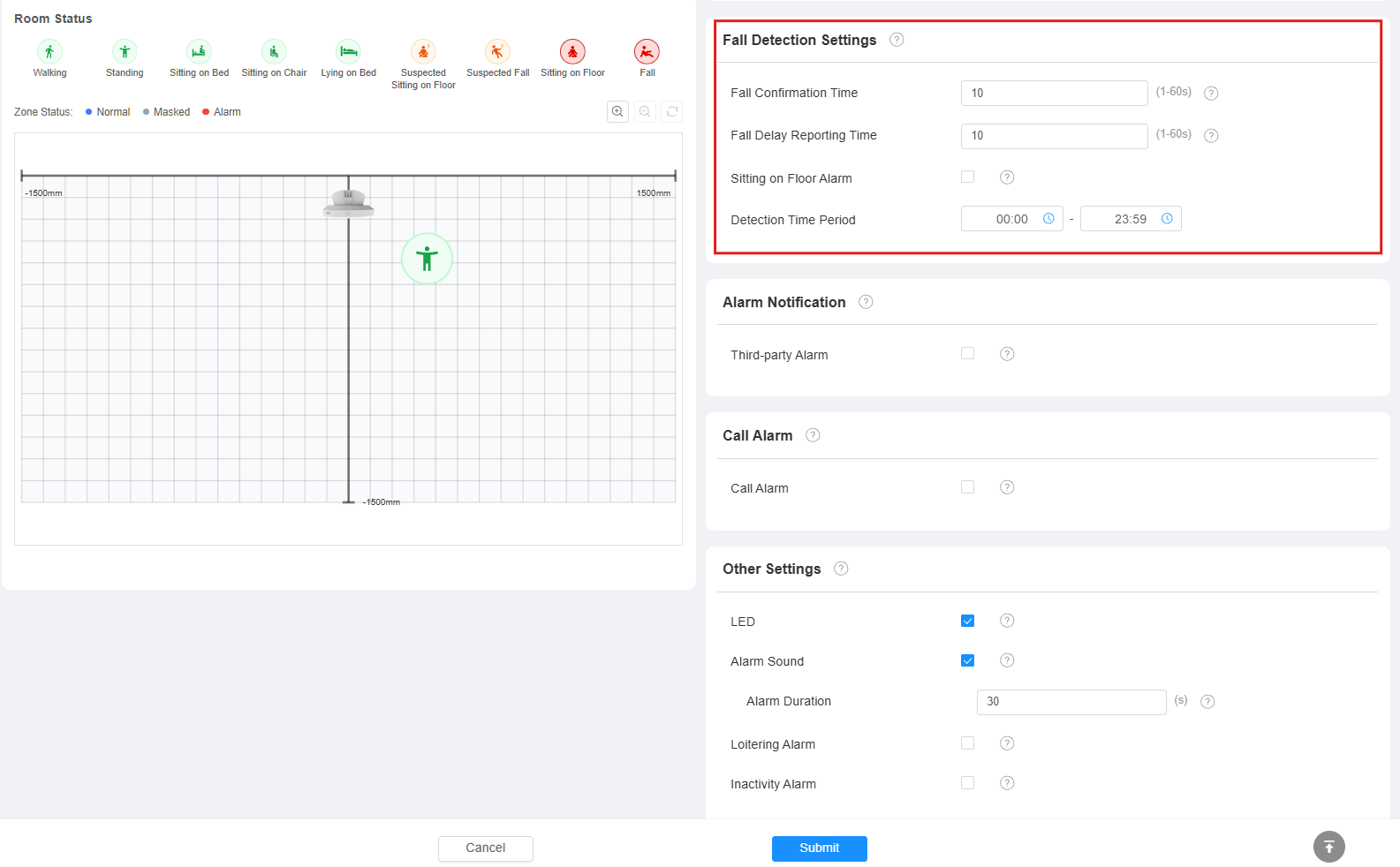
Fall Confirmation Time: The time threshold for confirming a fall. When the duration of the fall event reaches this value, it will be considered a fall event, triggering an alarm. Default: 10 seconds. Range: 1–60 seconds.
Fall Delay Reporting Time: When the duration of the fall event reaches this value, it will be reported to the cloud, SDMC, indoor monitor, guard phone, or third-party system. Default: 10 seconds. Range: 1–60 seconds.
Sitting on Floor Alarm: The detection of a person sitting on the floor.
Sitting on Floor Detection Time: The duration required to confirm a sitting-on-floor event. Range: 10-200 seconds.
Detection Time Period: The period when fall and sitting-on-floor detections are active.
Vital Sign Detection Settings
When the device is in Sleep Monitoring or Full Function working mode, you can configure the vital-sign ranges used to detect abnormal breathing or heart rate, and set up alarms when a person's vital signs cannot be reliably monitored during sleep.
Set them up on the Fall Settings > General Settings > Vital Signs Settings interface.
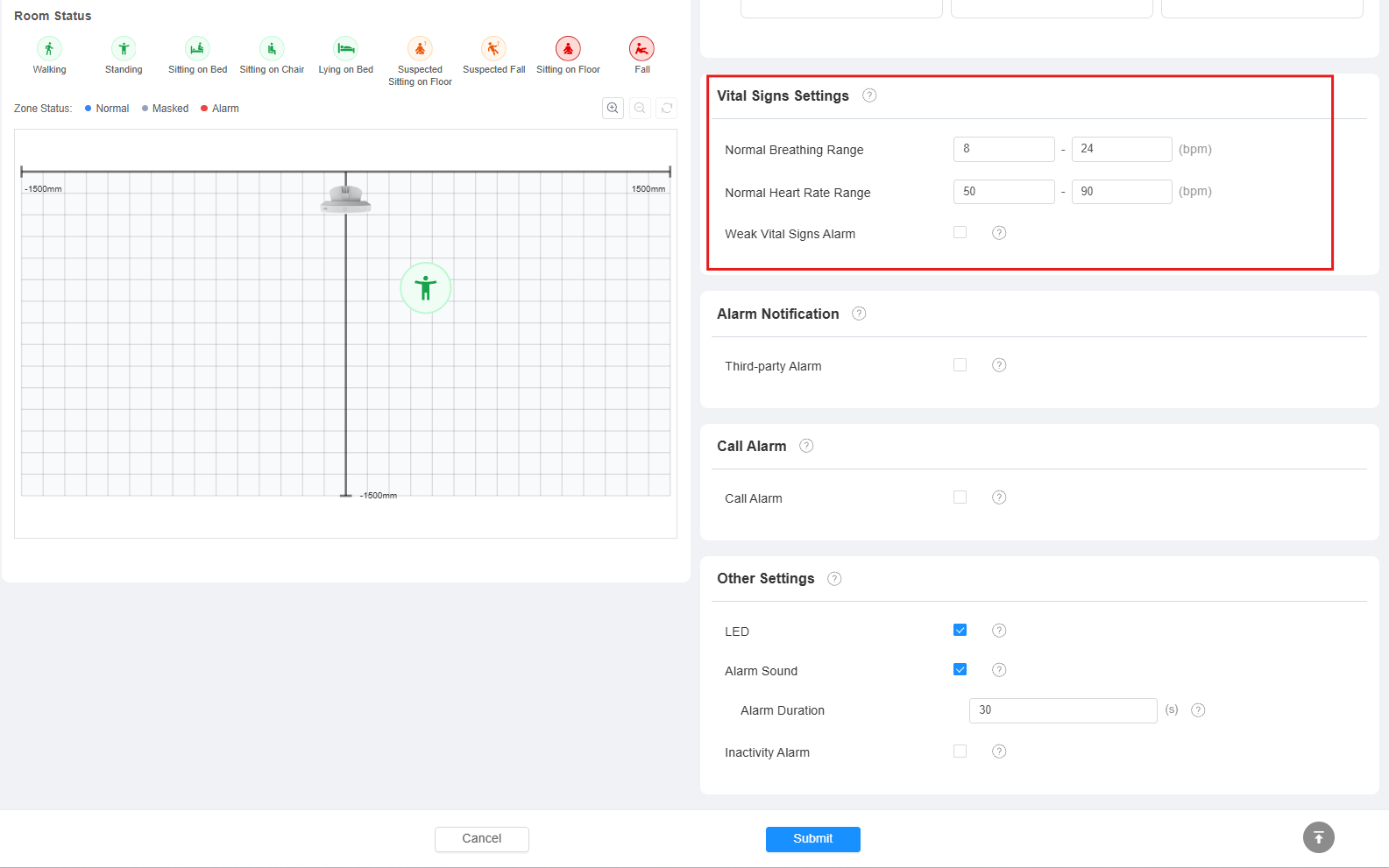
Normal Breathing Range: The acceptable breathing rate range used for abnormal breathing detection. When the detected breathing rate exceeds or falls below this range, MR03 generates corresponding breathing events. The default range is 8–24 breaths/min.
Normal Heart Rate Range: The acceptable heart rate range used for abnormal heart rate detection. When the detected heart rate exceeds or falls below this range, MR03 generates corresponding heart rate events. The default range is 50–90 bpm.
Weak Vital Signs Alarm: Disabled by default. When enabled, MR03 monitors the breathing rate and heart rate of a person in the bed area. An alarm is triggered when either the breathing rate or heart rate remains below its configured lower threshold continuously for 2 minutes.
The alarm is automatically cleared when the corresponding vital sign returns to the configured normal range and remains normal for more than 60 seconds.
Sub-region Settings
You can divide the room space into multiple functional regions to enable different detection behaviors within each area.
Add sub-regions on the Fall Settings > Subregions interface.
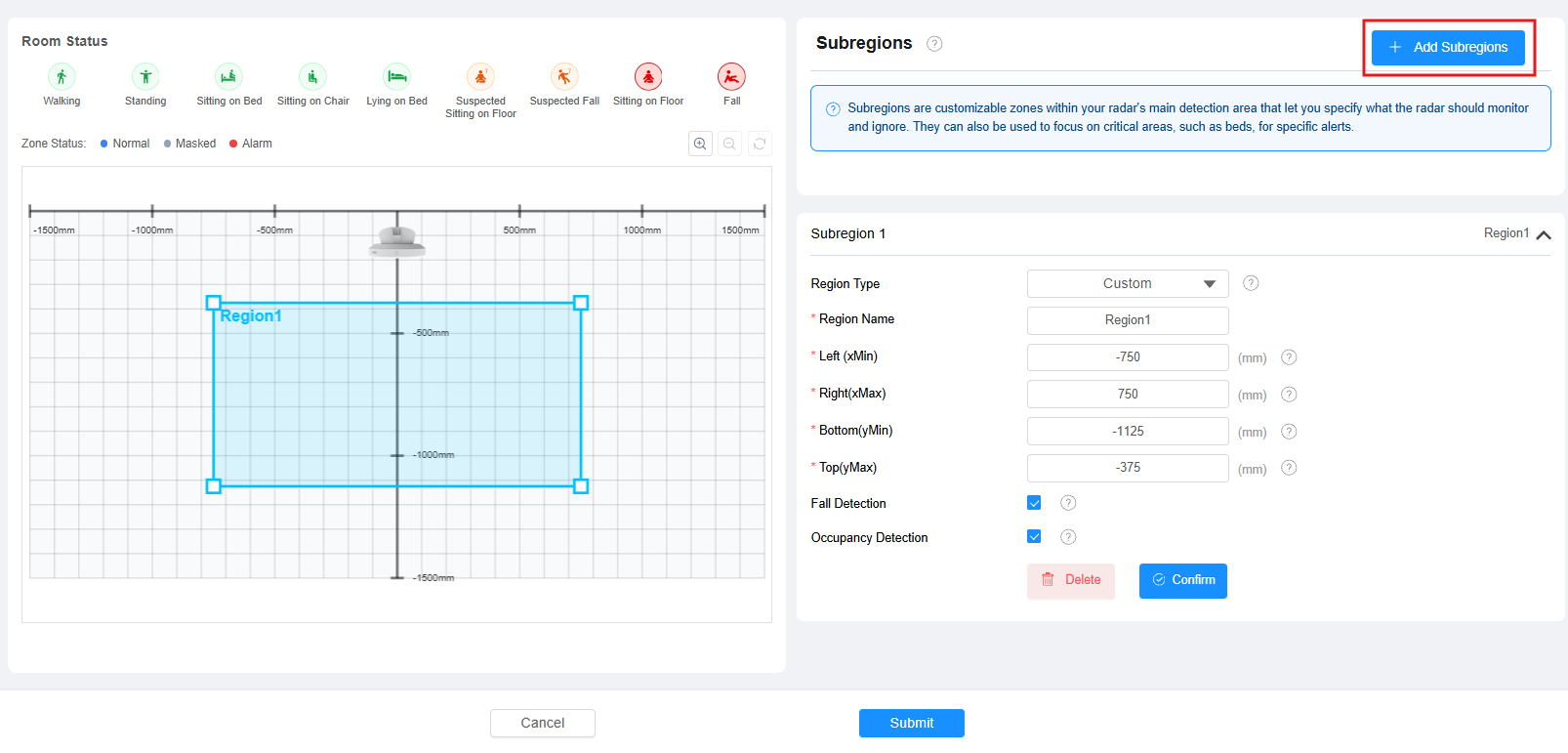
Add Subregions: Click +Add Subregions to add a sub-region, and a default sub-region will be created at the spatial coordinates.
You can adjust the size of the subregion by dragging the edges and vertices of the quadrilateral, and the corresponding coordinates will change accordingly.
A maximum of 6 subregions can be added.
Region Type: The default is Custom.
Custom: General-purpose region. Support fall & occupancy detection.
Door: Entrance area. Support fall & occupancy detection.
Bed: Bed area. Support bed-exit detection.
Shield: Excluded area. No fall detection.
Region Name: Set the region name, which will display on the Room Status spatial coordinate.
Subregion Coordinates: Specify the spatial boundaries of each subregion using the same coordinate system as the room.
Left(xMin): The minimum x-coordinate of the subregion.
The default value is half of the minimum x-coordinate of the space, and the input range is from the minimum x-coordinate to the maximum x-coordinate of the space.
Right(xMax): The maximum x-coordinate of the subregion.
The default value is half of the maximum x-coordinate of the space, and the input range is from the minimum x-coordinate to the maximum x-coordinate of the space.
Bottom(yMin): The minimum y-coordinate of the subregion.
The default value is half of the minimum y-coordinate of the space, and the input range is from the minimum y-coordinate to the maximum y-coordinate of the space.
Top(yMax): The maximum y-coordinate of the subregion.
The default value is half of the maximum y-coordinate of the space, and the input range is from the minimum y-coordinate to the maximum y-coordinate of the space.
Fall Detection: Available when the Custom or Door region type is selected. Enabled by default, and falls will be detected within this subregion.
Occupancy Detection: Available when Custom or Door region type is selected. Enabled by default, and it detects whether there are individuals occupying this subregion.
When selecting the Bed region type, further configure the following options.
Bed-exit Detection: An alarm will only be triggered if the individual leaves the bed after the Bed-exit Time Threshold, after confirming they are in bed; if they return to the bed within 2 seconds, the bed-exit status will be cleared.
Bed-exit Time Threshold: The time threshold for bed-exit detection. The default is 60 seconds; if the target leaves the bed for longer than the set time, an alarm will be triggered and reported. The input range is from 1 to 900 seconds.
Schedule: Enable it to set the In-Bed Detection Start Time and In-Bed Detection End Time.
Room Status
The Room Status section displays real-time detection results, including personnel status, region status, and system state.
Check Room Status on the Fall Settings > Information or General Settings interface.
The spatial coordinates show the size of the space based on the set XY coordinates, with the center being the installation position of MR03.
You can click the - and + icons to zoom, and clicking the reset icon will restore the initial scale.
You can move the region up, down, left, or right by holding the left mouse button.
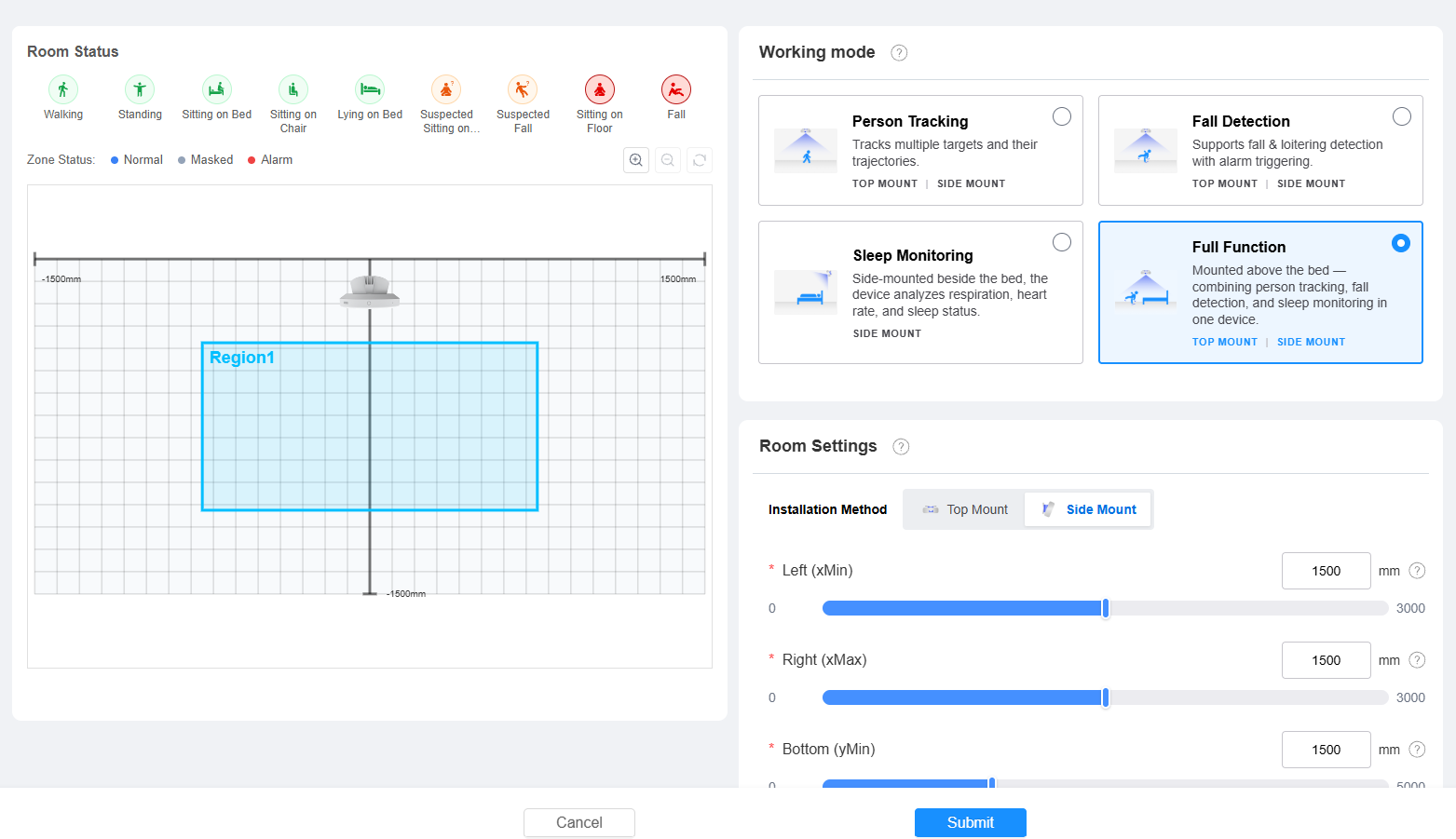
Subregion Status: If an alarm occurs, the region will be highlighted in red during the alarm.
Suspected Sitting on Floor: When the sensor detects a Suspected Sitting on Floor posture, it starts the configured Sitting on Floor Detection Time. During this period, the posture is displayed as Suspected Sitting on Floor. If the posture persists for the entire confirmation time, the sensor confirms the event and changes the posture to Sitting on Floor, triggering the sitting-on-floor alarm. If the condition is cleared before the confirmation time expires, the sitting-on-floor event is not confirmed.
Suspected Fall: When a Suspected Fall posture is detected, the sensor displays this posture during the configured Fall Confirmation Time. If it persists until the confirmation time expires, the event is confirmed as a Fall, and the fall alarm is triggered.