Tamper Alarm Setting
The tamper alarm function prevents anyone from removing the device without permission. Akuvox devices support two types of tamper proof: gravity detection and button status detection.
Click here to view which type is supported by the device and learn the function details.
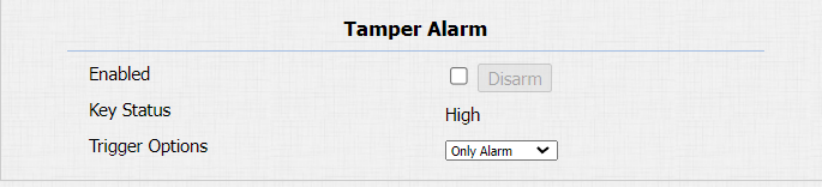
You can navigate to Security > Basic > Tamper Alarm.
Parameters Set-up:
-
Tamper Alarm: enable the anti-theft alarm function. When the tamper alarm goes off, you can press the Disarm tab beside the check box to clear the alarm.
-
Key Status: tamper alarm will not be triggered unless the key status is shifted from "Low" to "High" status.
-
Trigger Options: select what can be triggered when the gravity sensor is triggered.
Client Certificate Setting
Certificates ensure communication integrity and privacy. To use the SSL protocol, you need to upload the right certificates for verification.
Web Server Certificate
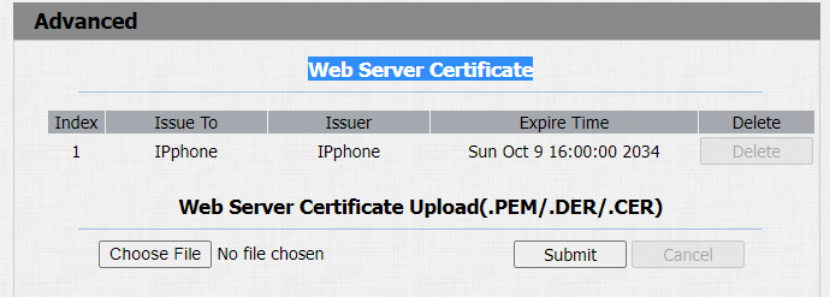
It is a certificate sent to the client for authentication when the client requests an SSL connection with the Akuvox door phone. Please upload the certificates in accepted formats.
To upload Web Server certificate on the device web interface Security > Advanced > Web Server Certificate.
Client Certificate
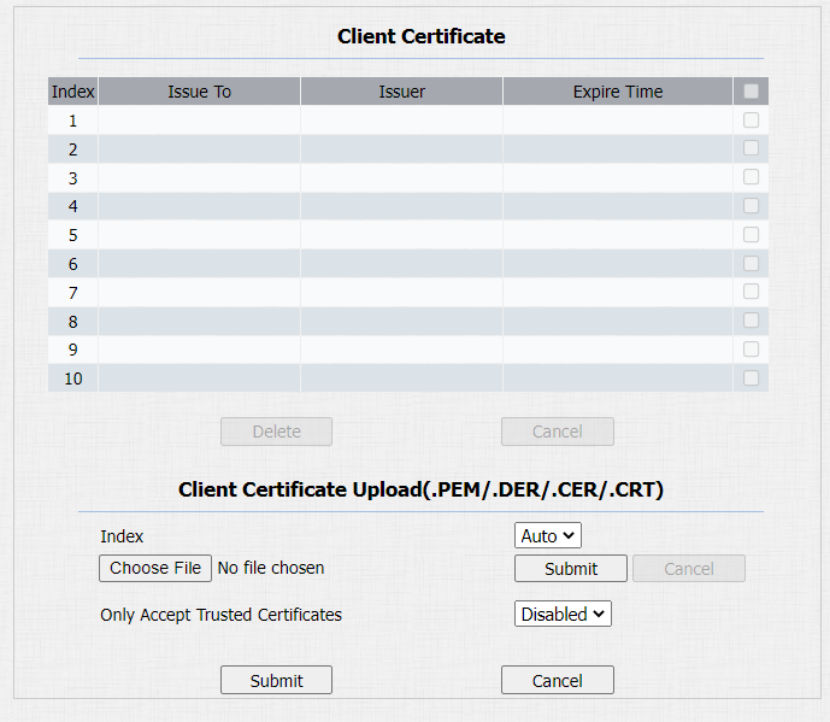
This certificate verifies the server to the Akuvox door phone when they want to connect using SSL. The door phone verifies the server's certificate against its client certificate list.
To upload and configure client certificate on the same page.
Parameters Set-up:
-
Index: select the desired value from drop-down list of Index. If you select Auto value, the uploaded certificate will be displayed in numeric order. If you select the value from 1 to 10, the uploaded certificate will be displayed according to the value that the user selected.
-
Select File: click Choose file browse local drive, and locate the desired certificate. (*.pem only)
-
Only Accept Trusted certificates: if select Enabled, as long as the authentication success, the phone will verify the server certificate based on the client certificate list. If select Disabled, the phone will not verify the server certificate no matter whether the certificate is valid or not.
Motion Detection
Motion Detection is a feature that allows unattended video surveillance and automatic alarms. It detects any changes in the image captured by the camera, such as someone walking by or the lens being moved, and activates the system to perform the appropriate action.
Configure Motion Detection
You can adjust various motion detection settings on the device web interface, such as the time interval, the sensitivity level, the notification method when motion is detected, and more.
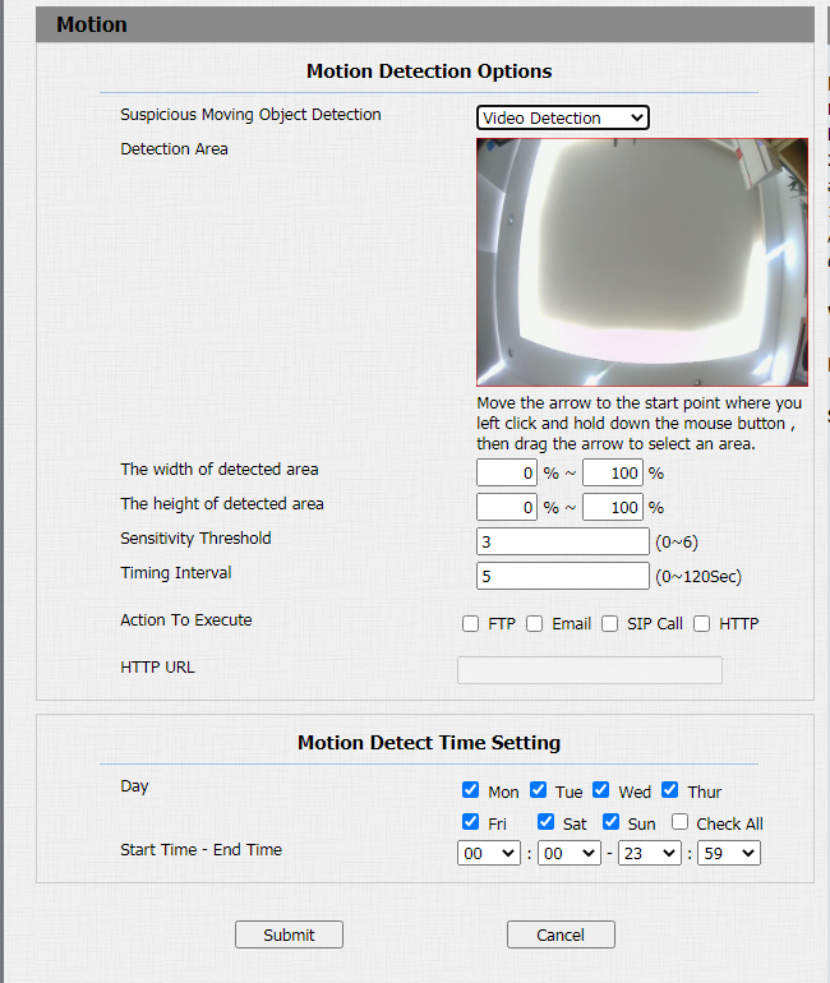
Path: Surveillance > Motion > Motion Detection Options.
Parameters Set-up:
-
Suspicious Moving Object Detection: select Disable to disable the motion detection. Select Video Detection to enable the video-based motion detection during the monitoring for the suspicious moving object.
-
Sensitivity Threshold: the higher threshold is, the higher sensitivity will be.
-
Time Interval: set the time interval for the motion detection. If you set the default time interval as “10” Sec, then the motion detection time span will be 10 seconds. Assuming that we set the time interval as “10” then, and the first movement captured can be seen as start point of the motion detection, and if the movement continues through 7 seconds of the 10 seconds interval, then the alarm will be triggered at 7 seconds ( the first trigger point) and motion detection action can be triggered (sending out notification) anywhere between 7-10 seconds once the movement is detected. “10” Sec interval is a complete cycle of the motion detection before it starts another cycle of the same time interval. To be more specific, the first trigger point can be calculated as the “Time interval minus three”.
Security Notification Setting
Email Notification Setting
Set up email notifications to receive screenshots of unusual motion from the device.
Click here to view how to set this feature up.
Navigate to Setting > Action > Email Notification interface. The email notification will show as the captures.
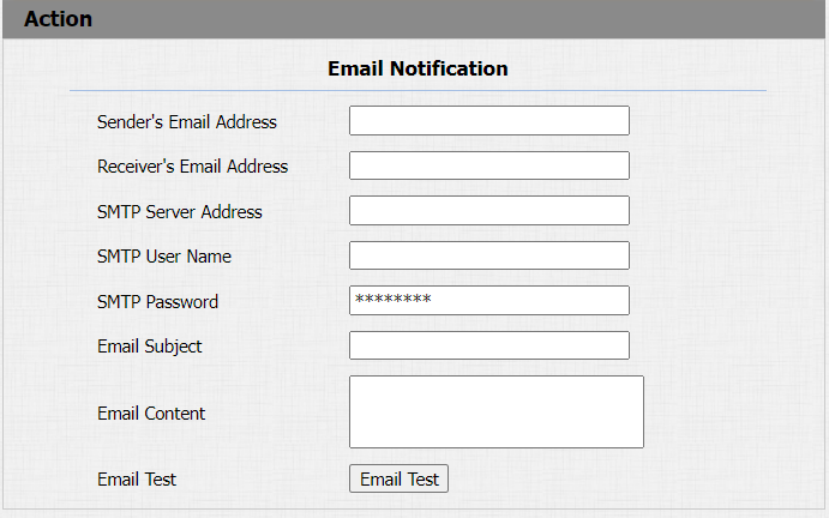
Parameters Set-up:
-
Sender's email address: enter the sender’s email address from which the email notification will be sent out.
-
Receiver's Email Address: enter the receiver’s email address.
-
SMTP Server Address: enter the SMTP server address of the sender.
-
SMTP User Name: enter the SMTP user name, which is usually the same as the sender’s email address.
-
SMTP Password: configure the password of SMTP service, which is the same as the sender’s email address.
-
Email Test: click Email Test to test if you can receive the Email.
FTP Notification Setting
To get notifications through FTP server, you need to set up the FTP settings. The door phone will upload a screenshot to the specified FTP folder if it senses any unusual motion.
Click here to view the configuration steps.
Go to Setting > Action > FTP Notification interface.
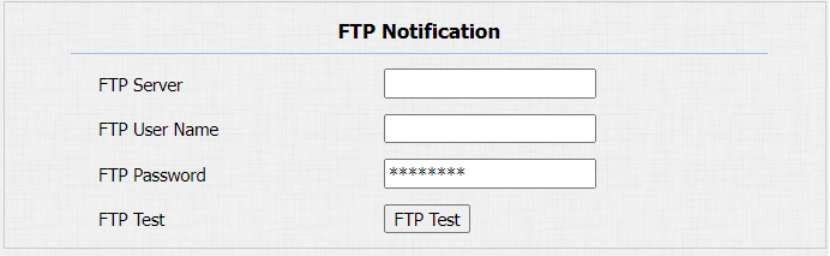
Parameters Set-up:
-
FTP Server: enter the address (URL) of the FTP server for the FTP notification.
-
FTP Test: run the test to see if FTP notification can be sent and received by the FTP server.
SIP Call Notification Setting
In addition to FTP and Email notification, the door bell can also make a SIP call when some feature action is triggered. To configure a SIP call notification on web Setting > Action > SIP Call Notification interface.

Parameters Set-up:
-
SIP Call Number: to configure SIP call number.
-
SIP Call Name: to configure display name of door bell.
HTTP URL Notification Configuration
Akuvox door phone support sending the HTTP notification to the third party when some features are triggered.
The URL format: http://http server IP address/any information. Refer to: Surveillance > Motion > Action to Execute.
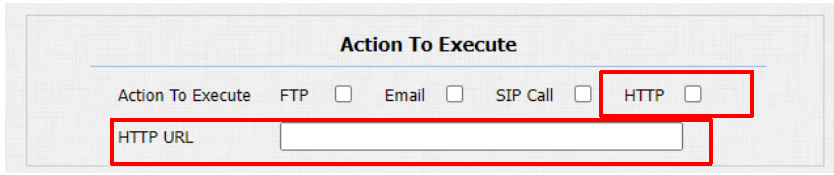
Parameters Set-up:
-
HTTP URL: tick the check box to enable HTTP URL notification.
-
HTTP URL: if you choose HTTP mode, enter the URL format: http://http server IP address/any information.
Security Action Configuration
Configure Push Button Action
When pressing the push button, the door bell will trigger the pre-configured action type, the notification can be sent out by Email, FTP notification or SIP call. To do this configuration on web Intercom > Basic interface.

Parameters Set-up:
- Action To Execute: to choose which action to be executed after triggering.
Configure Motion Action
When the Motion Detection feature is working, you can make it trigger an action. To do this configuration on web Surveillance > Motion interface.

Configure Input Action
When Input interface is working , it can also trigger an action. You can do this configuration on web Access Control > Input interface.

Parameters Set-up:
- Action to execute: to choose which action to execute after triggering.
Voice Encryption
Secure Real-time Transport Protocol (SRTP) is a protocol derived from the Real-time Transport Protocol (RTP). It enhances the security of data transmission by providing encryption, message authentication, integrity assurance, and replay protection.
To configure this feature on web Account > Advanced > Encryption interface.

Parameters Set-up:
- Voice Encryption(SRTP): choose Disabled, Optional or Compulsory for SRTP. If it is Optional or Compulsory, the voice during the call is encrypted, and you can grab the RTP packet to view.
User Agent
User agent is used for identification purpose when you are analyzing the SIP data packet.
You can customize user agent field in the SIP message. If user agent is set to a specific value, users can see the information from PCAP. If user agent is blank, by default, users can see the company name “Akuvox”, model number and firmware version from PCAP. Path: Account > Advanced > User Agent.

Parameters Set-up:
- User Agent: support to enter another specific value, Akuvox is by default.