Tamper Alarm
The tamper alarm function prevents anyone from removing the device without permission. The device’s AUX IN can be connected to a sensor, detecting illegal movement of the device.
To set it up, go to the Access Control > Auxiliary Input interface.
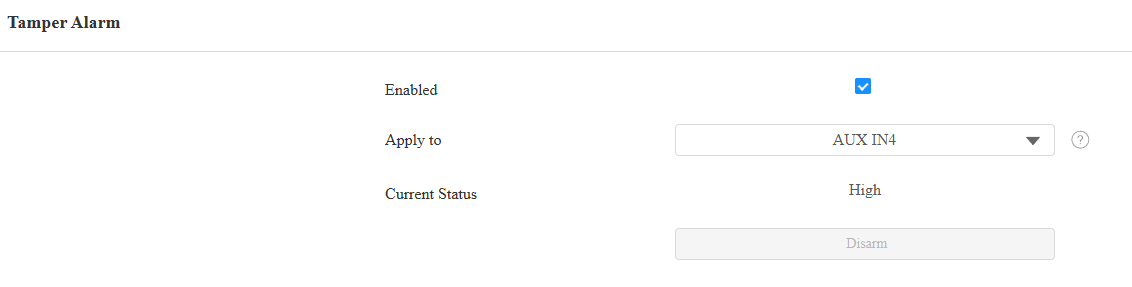
Disarm: When the tamper alarm goes off, you can press the Disarm tab to clear the alarm.
Apply To: The input that is connected to the detection sensor. The default is AUX IN4. When applying AUX IN to the tamper alarm, its settings will be unavailable.
Key Status: The tamper alarm will not be triggered unless the key status is shifted from Low to High status.
Note
The disarm tab will turn grey when the tamper alarm is cleared.
Disarm Setting
You can set the automatic disarm time and the time for users to disarm manually when alarms are triggered.
Set it up on the Access Control > Auxiliary Input > Disarm Setting interface.
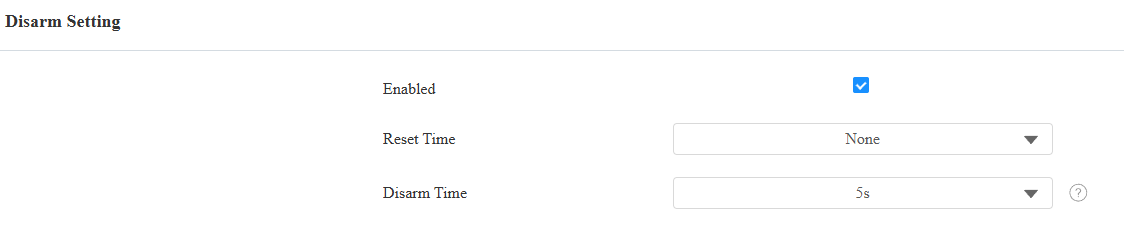
Enabled: The disarm feature is disabled by default.
Reset Time: Define the time(10-240 minutes) to clear the alarm automatically after the alarm is triggered.
Disarm Time: Admin users can use their credentials twice within the time to clear the alarm, like swiping the card twice, or entering the PIN followed by swiping the card.
Security Notification
A security notification informs users or security personnel of any breach or threat that the device detects. For example, if the device detects something unusual, the system sends a notification to users or security through email.
Click here to view how to set this feature up.
Set up email notifications on the Setting > Action interface.
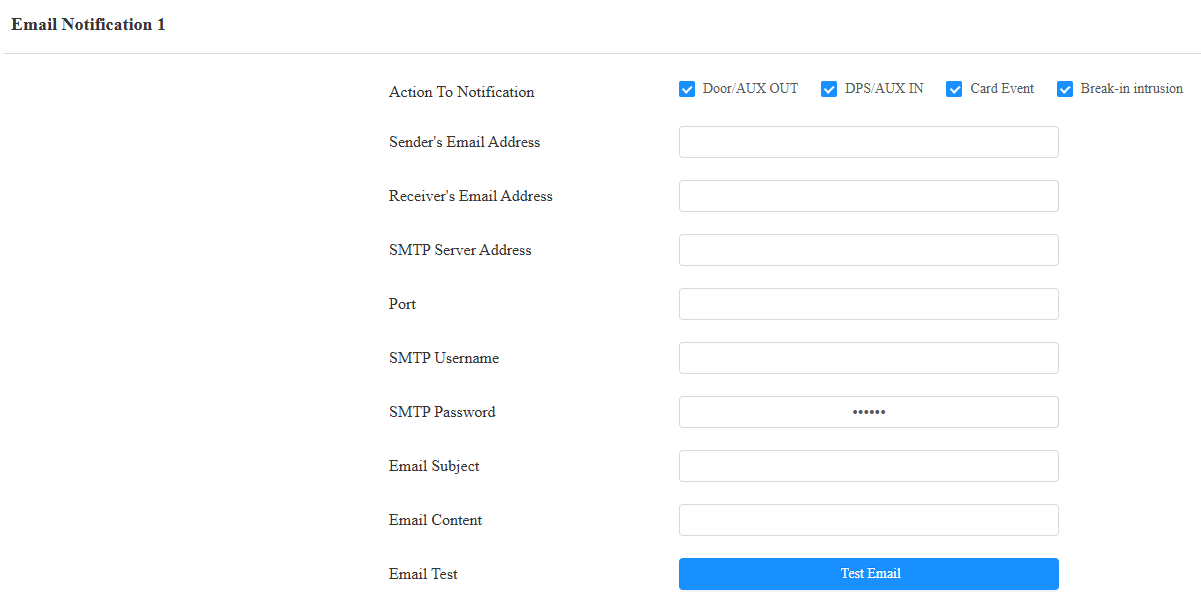
SMTP Server Address: The SMTP server address of the sender.
Port: SMTP server port.
SMTP Username: The SMTP username is usually the same as the sender's email address.
SMTP Password: The password of the SMTP service is the same as the sender's email address.
Email Test: Used to test whether the email can be sent and received.
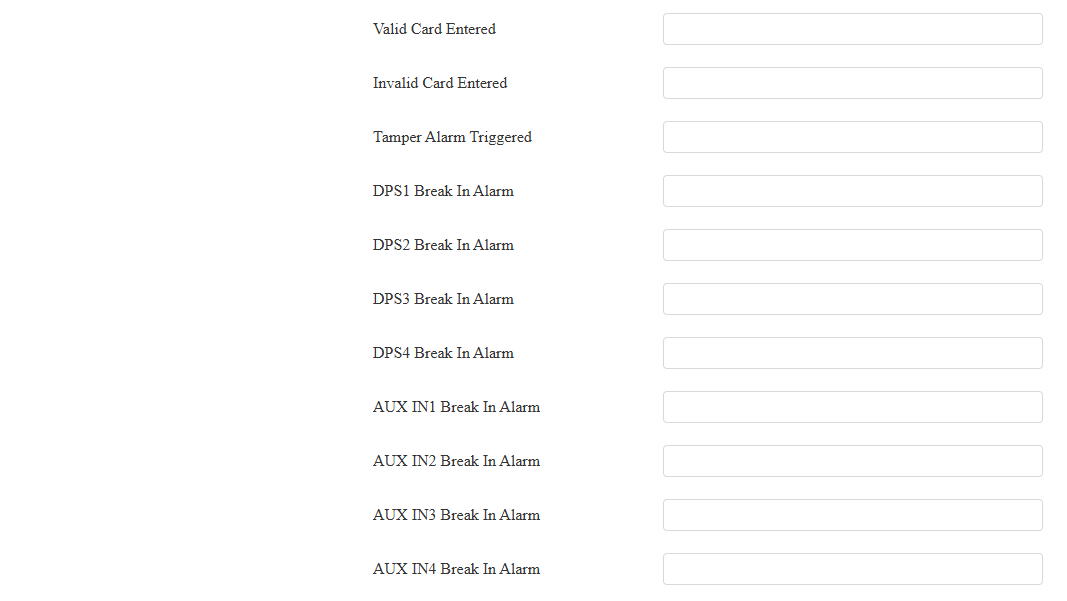
Action URL
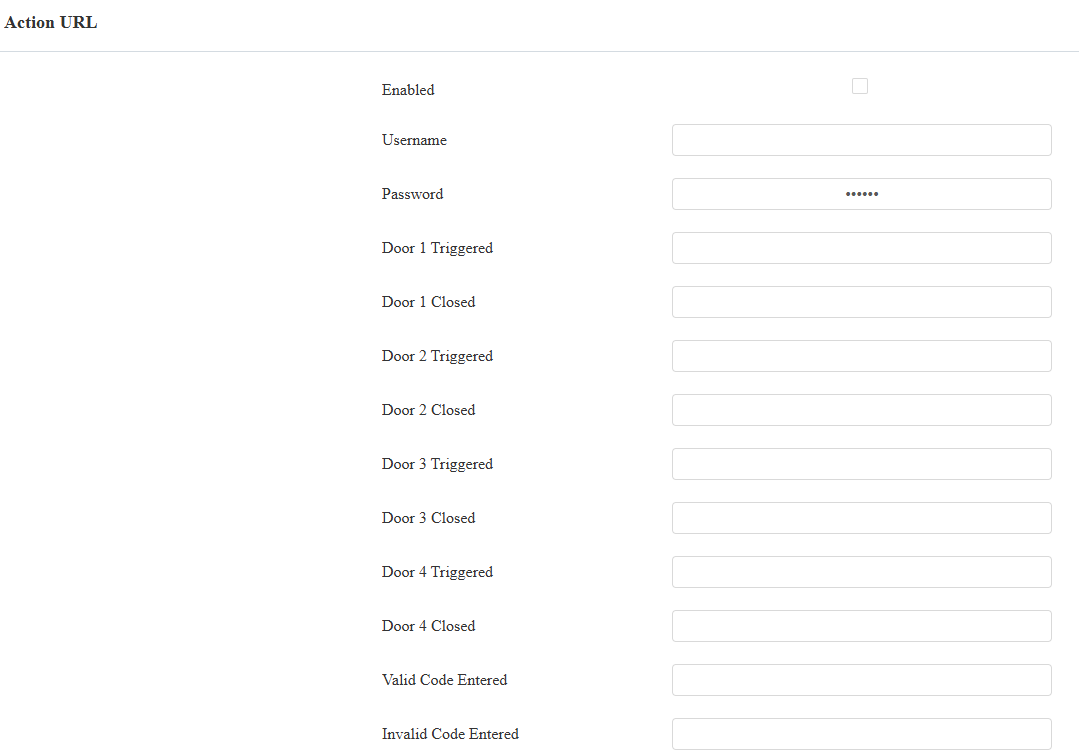
You can use the device to send specific HTTP URL commands to the HTTP server for certain actions. These actions will be triggered when the relay status, PIN code, RF card access changes, etc.
Akuvox Action URL:
No | Event | Parameter format | Example |
1 | Door Triggered | $relay1status | Http://server ip/relaytrigger=$relay1status |
2 | Door Closed | $relay1status | Http://server ip/relayclose=$relay1status |
3 | Valid Code Entered | $code | Http://server ip/validcode=$code |
4 | Invalid Code Entered | $code | Http://server ip/invalidcode=$code |
5 | Valid Card Entered | $card_sn | Http://server ip/validcard=$card_sn |
6 | Invalid Card Entered | $card_sn | Http://server ip/invalidcard=$card_sn |
7 | Tamper Alarm Triggered | $alarmstatus | Http://server ip/tampertrigger=$alarmstatus |
8 | DPS Break-in Alarm | $relay1status | Http://server ip/inputtrigger=$relay1status |
9 | AUX IN Break-in Alarm | $relay1status | Http://server ip/inputtrigger=$relay1status |
For example: http://192.168.16.118/help.xml? mac=$mac:ip=$ip:model=$model:firmware=$firmware:card_sn=$card_sn
To set it up, go to the Setting > Action URL interface. You can set up the username and password for authentication.
High Security Mode
High security mode is designed to enhance the security. It employs encryption across various facets, including the communication process, door opening commands, password storage methods, and more.
Disable High Security Mode on the System > Security interface. It is enabled by default.

Important Notes
1. The High Security mode is off by default when you upgrade the device from a version without the mode to one with it. But if you reset the device to its factory settings, the mode is on by default.
2. This mode makes the old version tools incompatible. You need to upgrade them to the following versions or higher to use them.
PC Manager: 1.2.0.0
IP Scanner: 2.2.0.0
Upgrade Tool: 4.1.0.0
SDMC: 6.0.0.34
3. The supported HTTP format for relay triggering varies depending on whether high secure mode is enabled or disabled.
If the mode is on, the device only accepts the new HTTP formats below for door opening.
http://username:password@deviceIP/fcgi/OpenDoor?action=OpenDoor&DoorNum=1
http://deviceIP/fcgi/OpenDoor?action=OpenDoor&DoorNum=1
If the mode is off, the device can use both the new formats above and the old format below:
http://deviceIP/fcgi/do?action=OpenDoor&UserName=username&Password=password&DoorNum=1
4. It is not allowed to import/export configuration files in tgz. format between a device with the high security mode and another one without it. For assistance with file transfer, please contact Akuvox technical support.
Web Interface Automatic Log-out
You can set up the web interface's automatic log-out timing, requiring re-login by entering the user name and the passwords for security purposes or for the convenience of operation.
To set it up, navigate to the web System > Security interface.

Real-time Monitoring
This feature displays the door status when the device is connected to the SmartPlus Cloud. Property managers and end users can check the door status, respectively, on the SmartPlus Property Manager platform and SmartPlus App. You need to specify the relay(s) or input(s) that apply this feature.
Click here to see the detailed configuration.
Set it up on the System > Security interface.

Apply Setting To:
None: Not display door status.
REX: The door is opened by triggering the input(pressing the exit button).
Door: The door is opened by triggering the relay.
Emergency Action
This feature can keep the door(s) open when an emergency happens(the input is triggered). You need to specify the Input that applies the feature.
Set it up on the System > Security > Emergency Action interface.
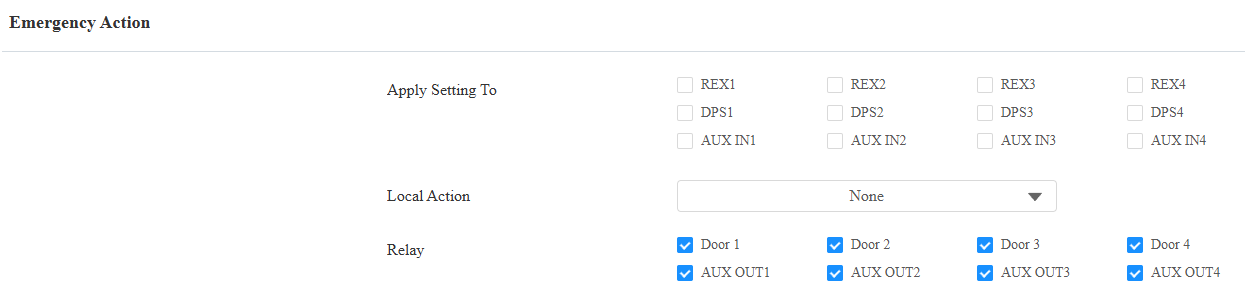
Local Action: Set whether to open doors with the input trigger. An option called “End Now” will be available when the door is opened. You can click it to close it.
None: Disable the feature.
Time: Set the duration time of the door opening.
Always: The door keeps open.
Note
When the device is deployed on the SmartPlus Cloud, property managers can apply emergency actions and the local action will be overwritten. For example, when the door is set to be activated for 5 minutes. At 3 minutes, the Cloud issues the Emergency Unlock action, the door will not be closed after 5 miniutes but only closed when the Cloud issues the Emergency Close action.