Unlock by Public PIN Code
The device supports public pin codes for administrators or cleaners to open the door.
To set up the public PIN code, go to Access Control > Relay > Public PIN interface.

PIN Code: Set a 2-8 digit PIN code accessible for universal use.
User-specific Access Methods
The private PIN code, RF card, and license plate should be assigned to a particular user for opening doors.
When adding a user, you can also customize settings such as defining the door access schedule to determine when the code is valid and specifying which relay to open.
To add a user, go to Directory > User interface and click +Add.
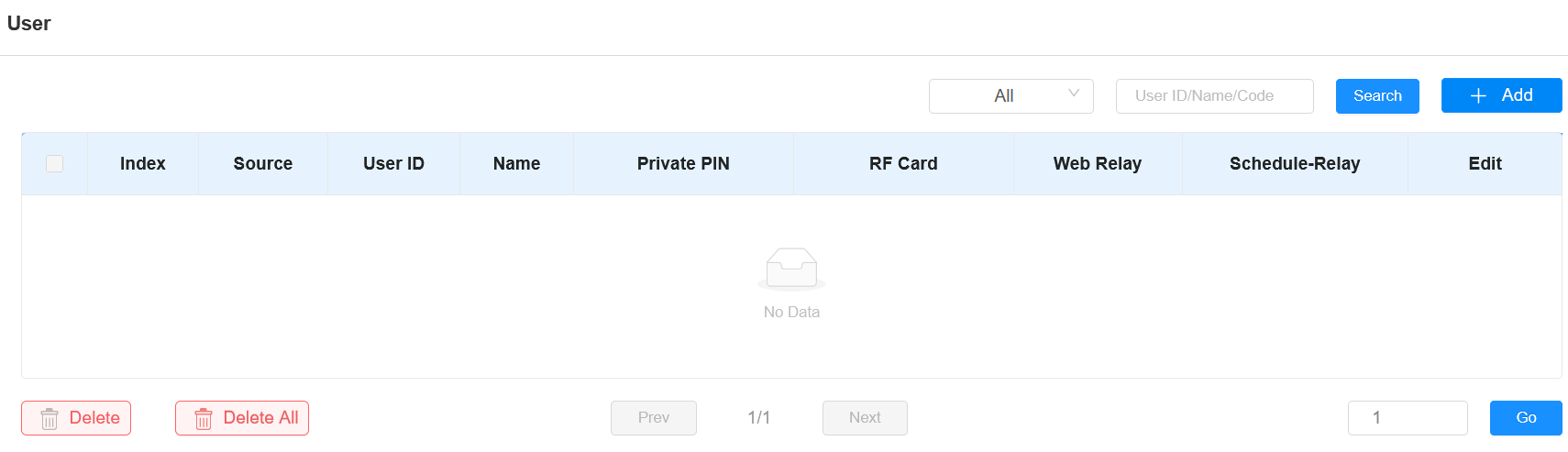

User ID: The unique identification number assigned to the user.
Name: The name of this user.
Unlock by Private PIN Code
On the Directory > User > +Add interface, scroll to the Private PIN section.

Code: Set a 2-8 digit PIN code solely for the use of this user. Each user can only be assigned a single PIN code.
Unlock by RF Card
On the Directory > User > +Add interface, scroll to the RF Card section.

Code: The card number that the card reader reads.
Note
Each user can have a maximum of 5 cards added.
The device allows to add 50,000 users.
RF cards operating at 13.56 MHz and 125 KHz frequencies are compatible with the door phone for access.
Events Triggered by Using RF Cards
You can set up the events triggered by swiping the RF cards on the Access Control > Card Setting interface.

Action to Execute: Set the desired actions that occur when the door is opened by swiping the RF card.
Email: Send a message to the preconfigured Email address.
HTTP: When triggered, the HTTP message can be captured and displayed in the corresponding packets. To utilize this feature, enable the HTTP server and enter the message content in the designated box below.
HTTP URL: Enter the HTTP URL if selecting HTTP as the action to execute. The format is http://HTTP server’s IP/Message content.
Unlock by License Plate
Akuvox offers two main ways to identify vehicles and open gates.
Use a third-party LPR(License Plate Recognition) camera to recognize the license plate of the vehicle.
Use the Akuvox long-range card reader ACR-CPR12 to recognize the UHF card attached to the vehicle's windshield.
To assign the license plate to a user, find the License Plate part on the Directory > User > +Add interface.

Add: A user can have up to 5 license plates.
Duration: Enable/disable Long-term Vehicle. It is enabled by default. If disabled, specify when the vehicle can enter or exit the parking lot.
Access Setting
You can customize access settings, such as defining the door access schedule to determine when the code is valid and specifying which relay to open.
On the Directory > User > +Add interface, scroll to the Access Setting section.
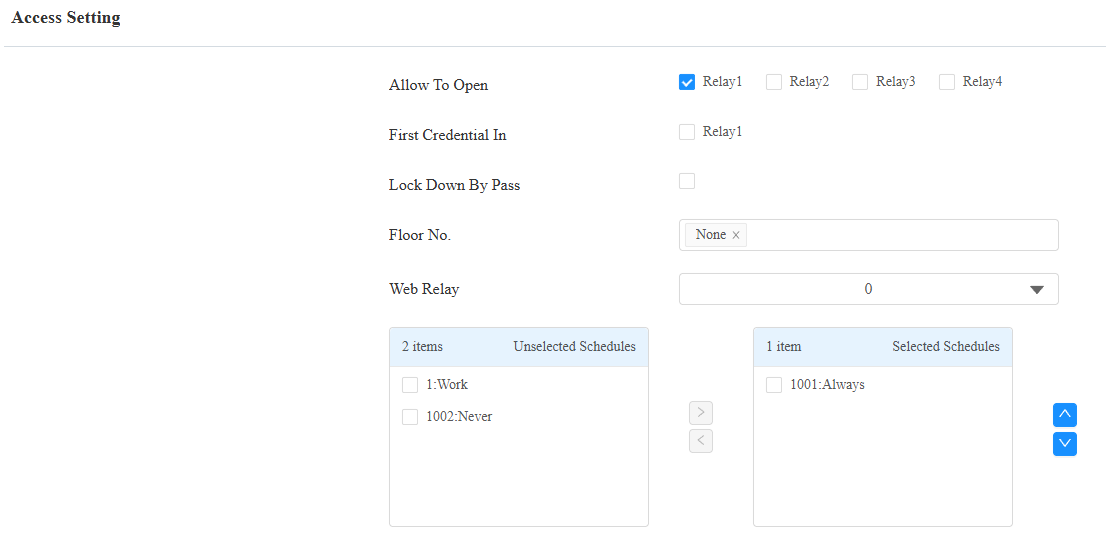
Allow To Open: Specify the relay(s) to be unlocked using the door opening methods assigned to the user.
First Credential In: This decides whether the user can keep the door open during the scheduled time after activating it.
Lockdown Bypass: This decides whether the user can open the door when the door is locked during the scheduled time.
Floor No.: Specify the accessible floor(s) to the user via the elevator.
Web Relay: Specify the ID of web relay action commands that you’ve configured on the Web Relay interface. A default value of 0 indicates that the web relay will not be triggered.
Schedule: Grant the user access to open designated doors during preset periods by relocating the desired schedule(s) from the left box to the right one. Besides custom schedules, there are 2 default options:
Always: Allows door opening without limitations on door open counts during the valid period.
Never: Prohibits door opening.
Import and Export User Data
You can import and export the user data on the Directory > User > Import/Export User interface. The files are in TGZ format.

Access Authentication
The device allows dual authentication for door access, using a combination of two methods: RF card and PIN. When the mode is set up, users must open the door in the order of the chosen method.
Set it up on the Access Control > Relay > Access Authentication Mode interface.

Authentication Mode: Determine how to unlock the door using different methods. Please note that the order of the two-factor authentication matters.
Any Method: Allows all access methods.
RF Card + PIN: Swipe the RF card first, then enter the PIN code.
Restriction Time(Sec): Specify the time within which the same user cannot open the door twice. For example, if it is set to 30 seconds, the user cannot open the door again until 30 seconds later.
Open Doors via HTTP Command
The device supports remote door unlocking via an HTTP command. Simply enable this feature and input the HTTP command (URL) for the device. This will trigger the relay and open the door, even if the users are away from the device.
To set it up, go to Access Control > Relay > Open Relay Via HTTP interface.
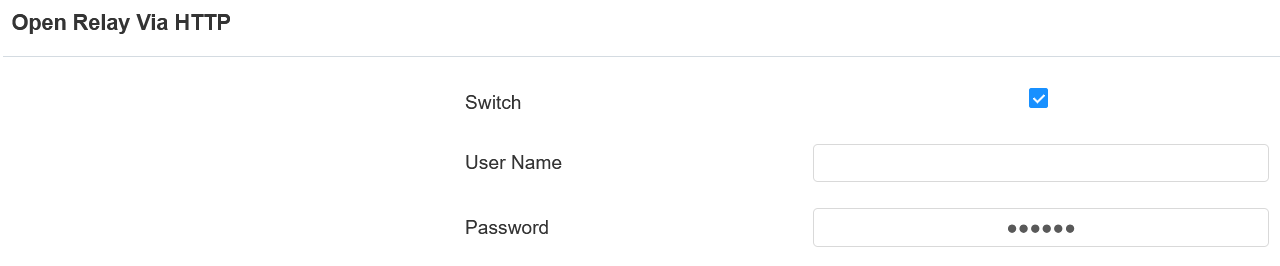
Username: Set a username for authentication in HTTP command URLs.
Password: Set a password for authentication in HTTP command URLs.
Tip:
Here is an HTTP command URL example for relay triggering.

Note
The HTTP format for relay triggering varies depending on whether the device's high secure mode is enabled. Please refer to this how-to guide Opening the Door via HTTP Command for more information.
Unlock by Exit Button
When users need to open the door from inside by pressing the Exit button, you need to set up the Input terminal that matches the Exit button to activate the relay for the door access.
Click here to watch the instruction video.
The device has 13 inputs, and 4 of them can be connected to the exit button.
To set it up, go to Access Control > Input interface.
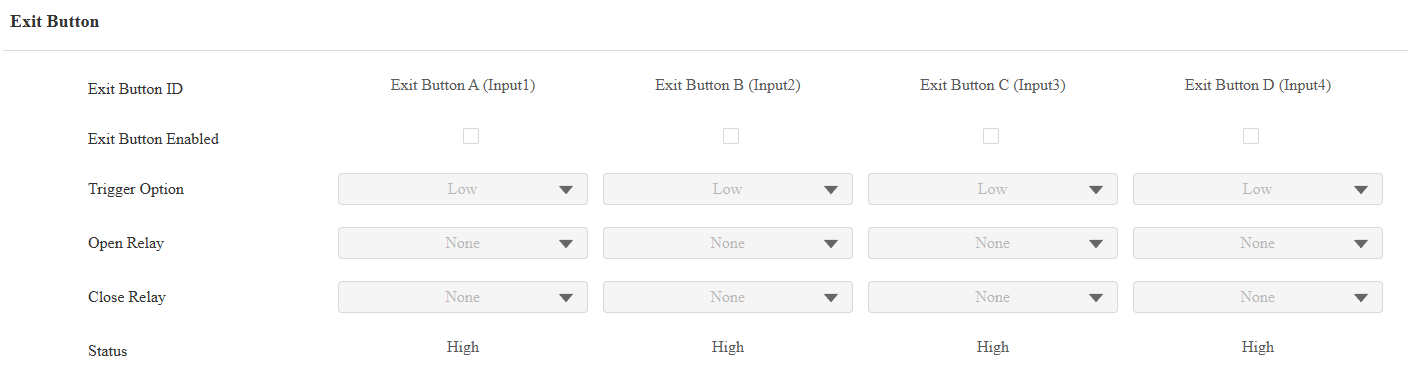
Exit Button Enabled: Specify a specific input interface used.
Trigger Option: Set the input interface to trigger at a low or high electrical level.
Open Relay: Specify the relay to be opened.
Close Relay: Specify the relay to be closed.
Status: Display the status of the input signal.
Unlock by Emergency Button
It is recommended to use general input for fire emergency applications as it facilitates organizing input connections and prevents miswiring. When the fire emergency button is activated, it will initiate predefined actions like opening doors and activating alarm sirens.
To set it up, navigate to the web Access Control > Input > General Input interface.
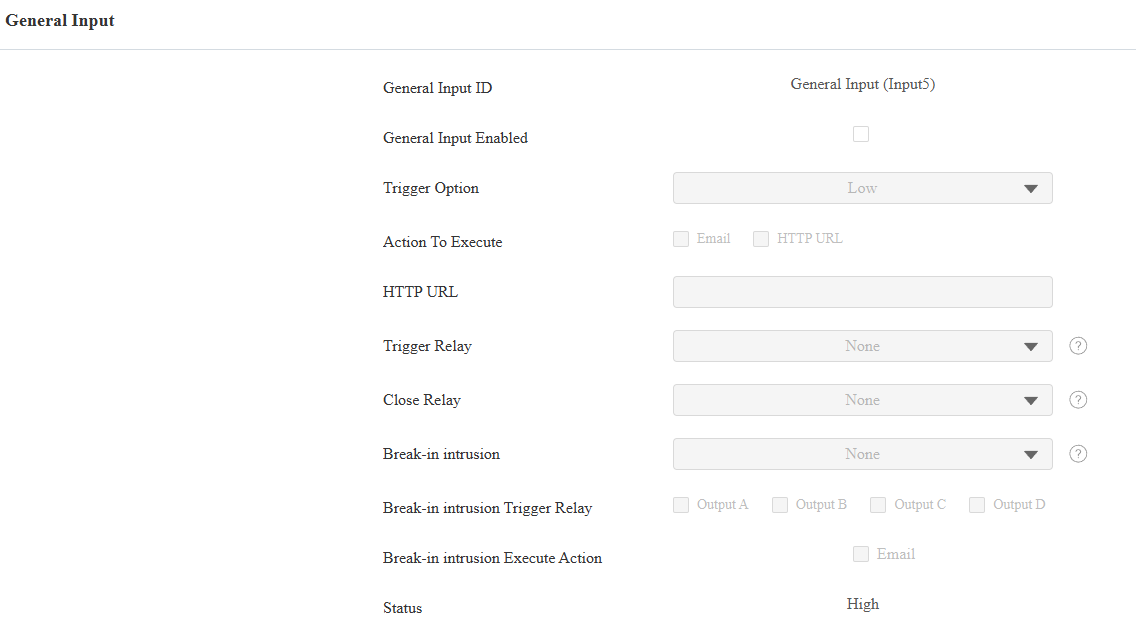
Trigger Option: Set the input interface to trigger at a low or high electrical level.
Action To Execute: Set the desired actions that occur when this Input interface is triggered.
Email: Send a message to the preconfigured Email address.
HTTP: When triggered, the HTTP message can be captured and displayed in the corresponding packets. To utilize this feature, enable the HTTP server and enter the message content in the designated box below.
HTTP URL: Enter the HTTP message if selecting HTTP as the action to execute. The format is http://HTTP server’s IP/Message content.
Trigger Relay: Specify the relay to be triggered.
Close Relay: Specify the relay to be closed when the input is triggered. Please note that this feature does not work during the relay schedule time.
Break-in intrusion: Activate an alarm when the door is forcibly or illegally opened. Only by checking off this option can the alarm be turned off once triggered. This feature is not compatible with the Trigger Relay and Close Relay functions.
Click here to learn more information about this feature.
Break-in intrusion Trigger Relay: Specify the relay(relay 5~8) to be opened.
Break-in intrusion Execute Action: Set whether to send a message to the preconfigured Email address when the break-in intrusion happens.
Status: Display the status of the input signal.
Door Magnetic Configuration
In addition to the above five inputs, the device has 8 extra inputs. Four of them(Door Magnetic A to D) can be connected to the door sensor for door-opening security.
To set it up, navigate to the web Access Control > Auxiliary Input interface.
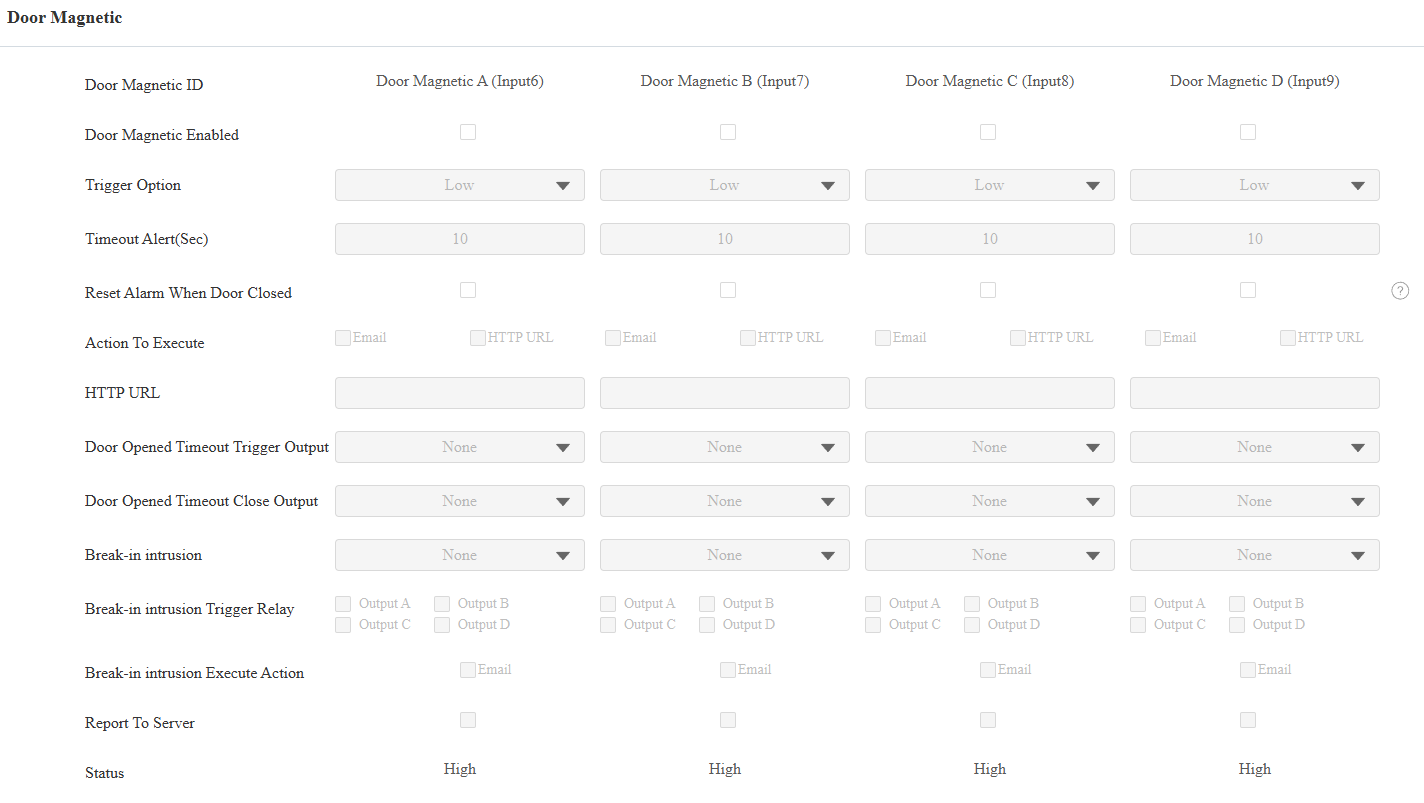
Door Magnetic Enabled: Specify the input used.
Trigger Option: Set the input interface to trigger at a low or high electrical level.
Timeout Alert(Sec): When the input trigger time exceeds this limit, an alert will be triggered.
Reset Alarm When Door Closed: Determine whether the door alarm output is automatically cleared when the door is closed.
If it is disabled(the default), when a timeout triggers the Output alarm, the alarm duration is determined by the Hold Delay configured for the Output, regardless of whether the door is closed.
If it is enabled, the Output alarm will be cleared automatically when the Input status is reset (for example, when the door is closed). In this case, the alarm stops immediately instead of waiting for the Hold Delay to expire.
Action to Execute: Set the desired actions that occur when this Input interface is triggered.
Email: Send a message to the preconfigured Email address.
HTTP: When triggered, the HTTP message can be captured and displayed in the corresponding packets. To utilize this feature, enable the HTTP server and enter the message content in the designated box below.
HTTP URL: Enter the HTTP message if selecting HTTP as the action to execute. The format is http://HTTP server’s IP/Message content.
Door Opened Timeout Trigger Output: Specify a relay output to be triggered along with the input.
Door Opened Timeout Close Output: Specify a relay output to be closed when the input is triggered. Please note that this feature does not work during the relay schedule time.
Break-in intrusion: Activate an alarm when the door is forcibly or illegally opened. Only by checking off this option can the alarm be turned off once triggered.
Click here to learn more information about this feature.
Break-in intrusion Trigger Relay: Specify the relay to be opened.
Break-in intrusion Execute Action: Set whether to send a message to the preconfigured Email address when the break-in intrusion happens.
Report to Server: Set whether to report the alarm logs to ACMS or SmartPlus Cloud, where the device is deployed, when the timeout alert is triggered.
Status: Display the status of the input signal.
Note
Outputs A, B, C, and D correspond to Relay 5, 6, 7, and 8.
Auxiliary Input Configuration
The remaining 4 auxiliary inputs can be connected to door sensors, smoke sensors, fire sensors, and IR motion detection sensors based on the actual application.
To set it up, navigate to the web Access Control > Auxiliary Input interface.
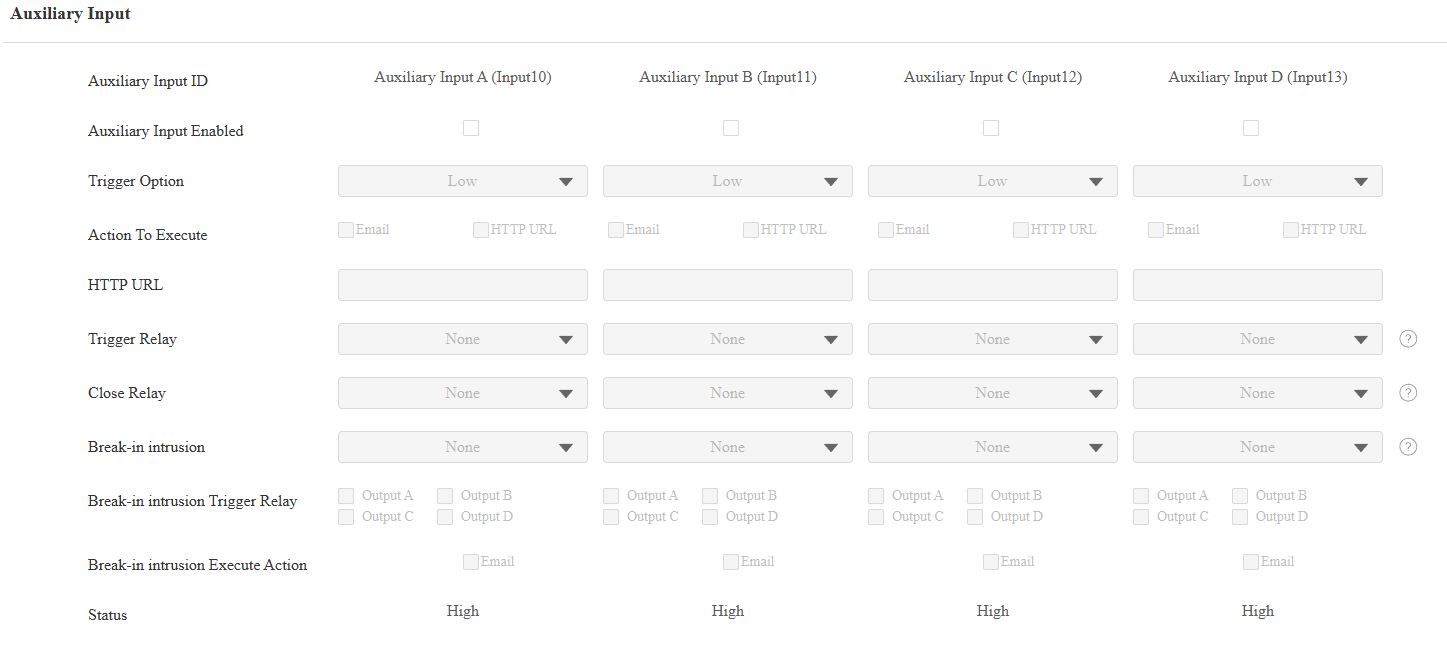
Auxiliary Input Enabled: Specify the input used.
Trigger Option: Set the input interface to trigger at a low or high electrical level.
Action To Execute: Set the desired actions that occur when this Input interface is triggered.
Email: Send a message to the preconfigured Email address.
HTTP: When triggered, the HTTP message can be captured and displayed in the corresponding packets. To utilize this feature, enable the HTTP server and enter the message content in the designated box below.
HTTP URL: Enter the HTTP message if selecting HTTP as the action to execute. The format is http://HTTP server’s IP/Message content.
Trigger Relay: Specify the relay to be triggered.
Close Relay: Specify the relay to be closed when the input is triggered. Please note that this feature does not work during the relay schedule time.
Break-in intrusion: Activate an alarm when the door is forcibly or illegally opened. Only by checking off this option can the alarm be turned off once triggered. This feature is not compatible with the Trigger Relay and Close Relay functions.
Click here to learn more information about this feature.
Break-in intrusion Trigger Relay: Specify the relay to be opened.
Break-in intrusion Execute Action: Set whether to send a message to the preconfigured Email address when the break-in intrusion happens.
Status: Display the status of the input signal.