Unlock by Public PIN Code
There are two types of PIN codes for door access: public and private. A private PIN is unique to each user, while the public one is shared by residents in the same building or complex. You can create and modify both the public and private PIN codes.
To set up the public PIN code, go to Intercom > PIN Setting > Public PIN interface.

PIN Code: Specify the public PIN code when enabling this feature. The code should be within 3-8 digits. The default is 33333333.
Tip
You can also modify the Public PIN on the device by pressing “*3888#” on the keypad to enter the Access Method Settings screen.
User-specific Access Methods
The private PIN code and RF card should be assigned to a particular user for door opening.
When adding a user, you can also customize settings such as defining the door access schedule to determine when the code is valid and specifying which relay to open.
To add a user, go to Intercom > User interface and click +Add.
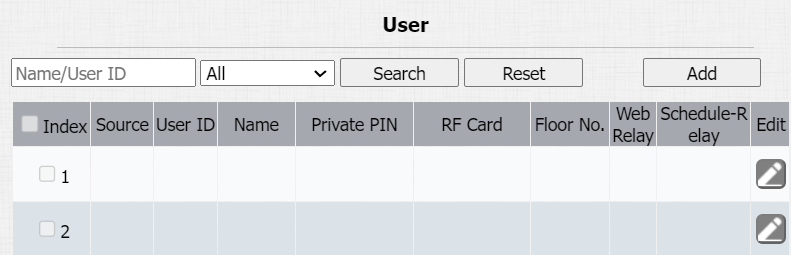

User ID: The unique identification number assigned to the user.
Name: The name of this user.
Unlock by Private PIN Code
On the Intercom > User > Add interface, find the Private PIN part.

Code: Set a 2-8 digit PIN code solely for the use of this user. A user can have multiple codes. Separate each code by “;”.
Tip
You can also modify the Private PIN on the device by pressing “*3888#” on the keypad to enter the Access Method Settings screen.
Then, enter the Admin Code “2396” to enter the Private PIN Adding and Deleting screen.
You can also disable the use of private PIN unlock. Go to the Intercom > PIN Setting > Private PIN interface.

Unlock by RF Card
On the Intercom > User > Add interface, find the RF Card part.

Code: The card number that the card reader reads.
Note
Each user can have a maximum of 5 cards added.
The device allows to add 5,000 users.
RF cards operating at 13.56 MHz and 125 KHz frequencies are compatible with the device for access.
You can enable and disable the use of RF cards on the Intercom > Card Setting interface.

Tip
You can also modify the user card on the device by pressing “*3888#” on the keypad to enter the Access Method Settings screen.
Then, enter the Admin Code “2396” to enter the User Card Adding and Deleting screen.
RF Card Code Format
To integrate the RF card door access with the third-party intercom system, you need to match the RF card code format with the one used by the third-party system.
To set it up, go to Intercom > Card Setting > RFID interface.
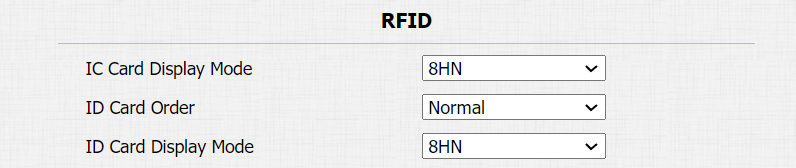
IC/ID Card Display Mode: Set the card number format from the provided options: 8H10D, 6H3D5D(W26), 6H8D, 8HN, 8HR, 6H3D5D-R(W26), and 8HR10D.
ID Card Order: Set the ID card reading mode between Normal and Reversed.
Actions Triggered by Swiping Cards
You can set actions triggered by swiping cards on the Intercom > Card Setting > Card Event interface.

Action to Execute:
FTP: Send a screenshot to the preconfigured FTP server.
Email: Send a screenshot to the preconfigured Email address.
HTTP: When triggered, the HTTP message can be captured and displayed in the corresponding packets. To utilize this feature, enable the HTTP server and enter the message content in the designated box below.
HTTP URL: Enter the HTTP message if selecting HTTP as the action to execute. The format is http://HTTP server’s IP/Message content.
Unlock by License Plate
Akuvox offers two main ways to identify vehicles and open gates.
Use a third-party LPR(License Plate Recognition) camera to recognize the license plate of the vehicle.
Use the Akuvox long-range card reader ACR-CPR12 to recognize the UHF card attached to the vehicle's windshield.
To assign the license plate to a user, find the License Plate part on the Directory > User > +Add interface.

Add: A user can have up to 5 license plates.
Duration: Enable/disable Long-term Vehicle. It is enabled by default. If disabled, specify when the vehicle can enter or exit the parking lot.
Access Setting
You can customize access settings, such as defining the door access schedule to determine when the code is valid and specifying which relay to open.
On the Intercom > User > Add interface, scroll to the Access Setting section.
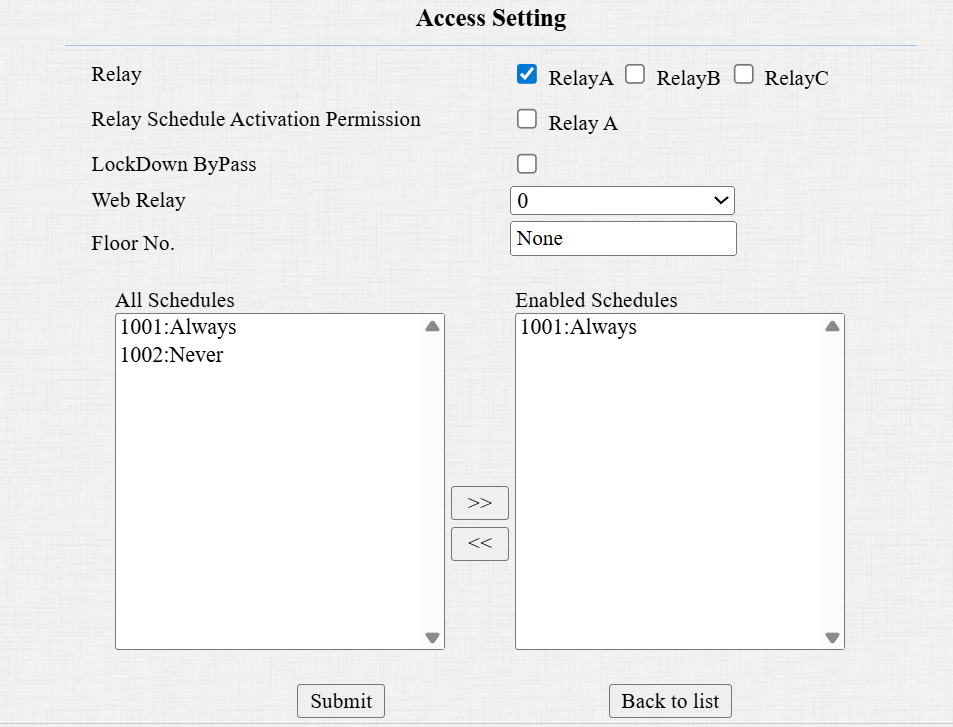
Relay: Specify the relay(s) to be unlocked using the door opening methods assigned to the user.
Relay Schedule Activation Permission: This decides whether the user can keep the relay open during the scheduled time after activating it.
Lockdown Bypass: This decides whether the user can open the door when the door is locked during the scheduled time.
Web Relay: Specify the ID of web relay action commands that you’ve configured on the Web Relay interface. A default value of 0 indicates that the web relay will not be triggered.
Floor No.: Specify the accessible floor(s) to the user via the elevator.
Schedule: Grant the user access to open designated doors during preset periods by relocating the desired schedule(s) from the left box to the right one. Besides custom schedules, there are 2 default options:
Always: Allows door opening without limitations on door open counts during the valid period.
Never: Prohibits door opening.
Import/Export User Data
The device supports access control user data to be shared among Akuvox devices through import and export, while you can also export the facial data and then import it to a third-party device.
Click here to view how to import and export user data between Akuvox devices.
To set it up, go to the Intercom > User > Import/Export User interface. You can add 5,000 users.
The import/export file should be in TGZ format.

AES Key For Import: When the imported file is encrypted, enter its password here.
Send Card Numbers to Third-Party Servers
The device supports sending card numbers to third-party servers when users swipe cards.
To set it up, go to the Intercom > Card Setting > Card Server interface.
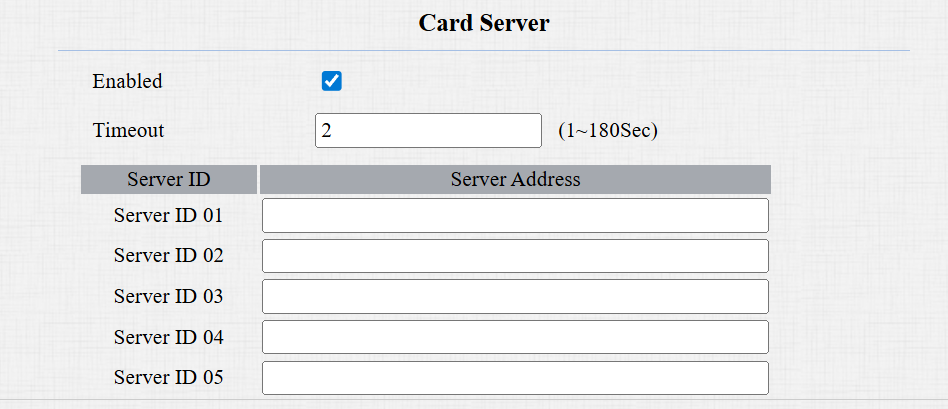
Enabled: Once enabled, when users swipe cards, the device will play a Di sound.
Timeout: Define the timeout of sending the card number(1~180 seconds).
For example, if it is set to 5 seconds, when the first server does not respond in 5 seconds, the device will try the next server.
This process continues through up to five servers until one of them responds.
If all five servers fail to respond, the device will repeat the cycle, with a maximum of three attempts in total.
Server Address: Support up to 5 addresses in HTTP/HTTPS format with a maximum of 256 characters and no restrictions on special characters.
Mifare Card Encryption
The device can read encrypted Mifare cards for greater security. When this feature is enabled, it reads the data in the cards’ designated sectors and blocks, not the UID.
Click here to view the details of encrypting and reading Mifare cards.
To set it up, go to Intercom > Card Setting > Mifare Classic Card Encryption interface.

Classic:
Sector/Block: Specify the location where encrypted card data is stored. A Mifare card has 16 sectors (numbered 0 to 15), and each sector has 4 blocks (numbered 0 to 3).
Block Key: Set a password to access the data stored in the predefined sector/block.
Plus: There are three block choices. The device can read the encrypted data in SL1 and SL3.
Block: The block number where the encrypted data is located.
SL3: The key number within 32 bits.
DesFire:
App ID: A 6-digit hexadecimal number
File ID: The ID of the encrypted file of the app, which can be a number from 0 to 16.
Crypto: The encryption method. It is AES by default.
Key: The file key.
Key Index: The index number for the key, which can be a number from 0 to 11.
Unlock by NFC
NFC (Near Field Communication) is a popular way for door access. It uses radio waves for data transmission interaction. The device can be unlocked by NFC. You can keep the mobile phone closer to the device for door access.
Enable or disable the NFC feature on the Intercom > Card Setting > Contactless Smart Card interface.

Note
The NFC feature is not available on iPhones.
Please refer to Open the Door via NFC for detailed configuration.
Unlock by HTTP Command
You can unlock the door remotely without approaching the device physically for door entry by typing in the created HTTP command (URL) on the web browser to trigger the relay when you are not available by the door for door entry.
To set it up, go to Intercom > Relay > Open Relay Via HTTP interface.
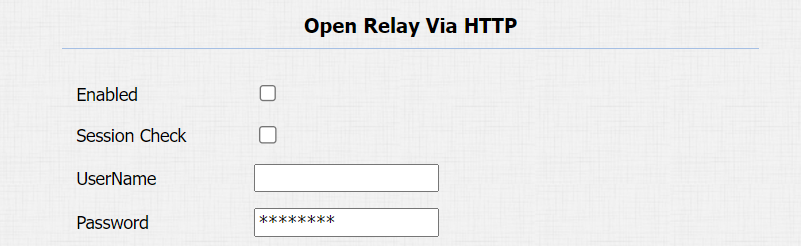
Session Check: When enabled, the HTTP unlock requires logging into the device’s web interface. Or, the door opening may fail.
Username: Set a username for authentication in HTTP command URLs.
Password: Set a password for authentication in HTTP command URLs.
Tip
Here is an HTTP command URL example for relay triggering.

Note
Click here to view how to set up door opening by HTTP commands.
Unlock by DTMF Code
Dual-tone multi-frequency signaling(DTMF) is a way of sending signals over phone lines by using different voice-frequency bands. Users can use the DTMF function to unlock the door for visitors during a call by either typing the DTMF code on the soft keypad, or tapping the unlock tab with the DTMF code on the screen.
To configure DTMF codes, go to Intercom > Relay interface.
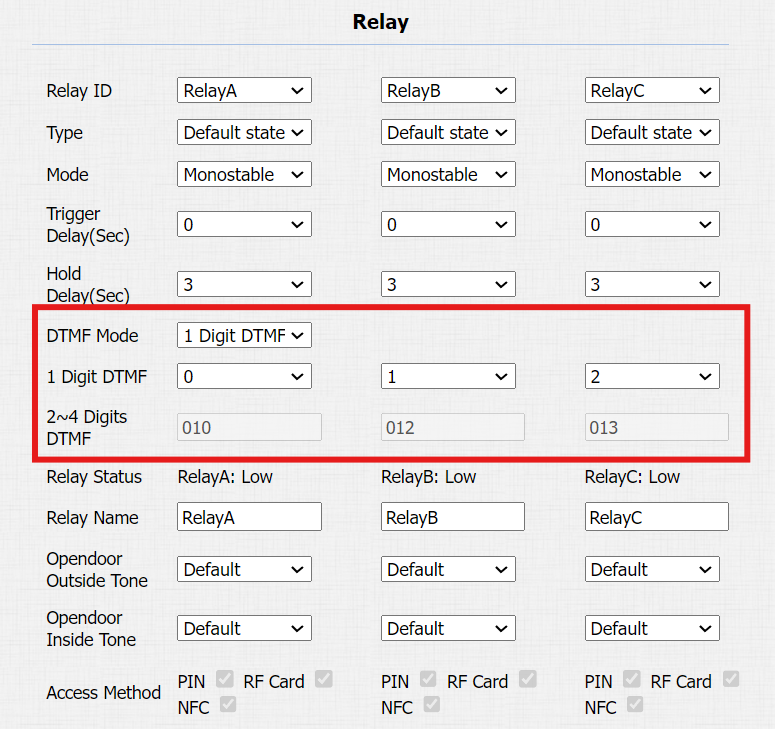
DTMF Mode: Set the number of digits for the DTMF code.
1 Digit DTMF: Define the 1-digit DTMF code within the range(0-9 and *,#) when the DTMF Mode is set to 1-digit.
2-4 Digit DTMF: Set the DTMF code based on the number of digits selected in the DTMF Mode.
Note
To open the door with DTMF, the intercom devices that send and receive the unlock command must use the same mode and code. Otherwise, the DTMF unlock may fail. See here for the detailed DTMF configuration steps.
DTMF White List
To secure door access via DTMF codes, you can set up the DTMF whitelist on the device web Intercom > Relay > Open Relay Via DTMF interface so that only the caller numbers you designated in the door phone can use the DTMF code to gain door access.

Assigned The Authority For: Specify the contacts authorized to open doors via DTMF:
None: No numbers can unlock doors using DTMF.
Only Contacts List: Doors can be opened by numbers added to the door phone's contact list.
All Numbers: Any numbers can unlock using DTMF.
DTMF Data Transmission
In order to achieve door access via DTMF code or some other applications, you are required to properly configure DTMF in order to establish a DTMF-based data transmission between the device and other intercom devices.
DTMF Type Differences:
Inband | DTMF signals are transmitted within the same audio channel as voice data. Simple implementation but signal distortion may occur with highly compressed codecs (e.g., G.729). |
RFC2833 | Transmits DTMF as special event packets over RTP (Real-Time Transport Protocol), known as out-of-band transmission. Reliable and unaffected by codecs. |
Info | Sends DTMF signals via SIP (Session Initiation Protocol) signaling channel. Separate from voice transmission, ensuring audio quality. |
Info+Inband | Combines Info and Inband methods. |
Info+RFC2833 | Combines both Info and RFC2833 methods. |
Info+Inband+RFC2833 | All three methods are used simultaneously. |
Set it up on the Account > Advanced > DTMF interface.
Type: Select from the following options: Inband, RFC2833, Info, Info+Inband, Info+RFC2833, or Info+Inband+RFC2833 based on the specific DTMF transmission type of the third-party device to be matched with as the party for receiving signal data.
How to Notify DTMF: Select Disabled, DTMF, DTMF-Relay, or Telephone-Event according to the specific type adopted by the third-party device. You are required to set it up only when the third-party device to be matched with adopts Info mode.
Payload: Set the payload according to the specific data transmission payload agreed on between the sender and receiver during the data transmission.
Unlock by Exit Button
When users need to open the door from inside by pressing the Exit button, you need to set up the Input terminal that matches the Exit button to activate the relay for the door access.
Click here to watch the instruction video.
To set it up, navigate to the Intercom > Input interface.
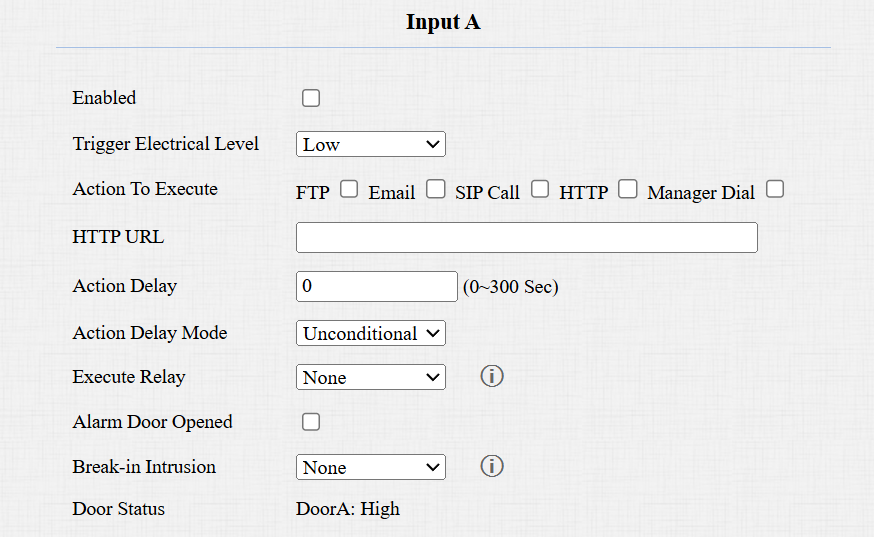
Enabled: To use a specific input interface.
Trigger Electrical Level: Set the input interface to trigger at a low or high electrical level.
Action To Execute: Set the desired actions that occur when the specific Input interface is triggered.
FTP: Send a screenshot to the preconfigured FTP server.
Email: Send a screenshot to the preconfigured Email address.
SIP Call: Call the preset number upon the trigger.
HTTP: When triggered, the HTTP message can be captured and displayed in the corresponding packets. To utilize this feature, enable the HTTP server and enter the message content in the designated box below.
Manager Dial: When the input is triggered, a call will be made to the number(s) set on the Intercom > Basic > Manager Dial interface.
HTTP URL: Enter the HTTP message if selecting HTTP as the action to execute. The format is http://HTTP server’s IP/Message content.
Action Delay: Specify how many seconds to delay executing the preconfigured actions.
Action Delay Mode:
Unconditional Execution: The action will be carried out when the input is triggered.
Execute If Input Still Triggered: The action will be carried out when the input stays triggered. For example, if the door stays open after triggering input, an action such as an email will be sent to notify the receiver.
Execute Relay: Specify the relay to be triggered by the actions.
Alarm Door Opened: If enabled, when the door-opening time exceeds a limit, an alarm will be triggered.
Door Opened Timeout: The door-opening time limit.
Break-in Intrusion: Activate an alarm when the door is forcibly or illegally opened. Only by checking off this option can the alarm be turned off once triggered. Click here to learn more information about this feature.
Door Status: Display the status of the input signal.